
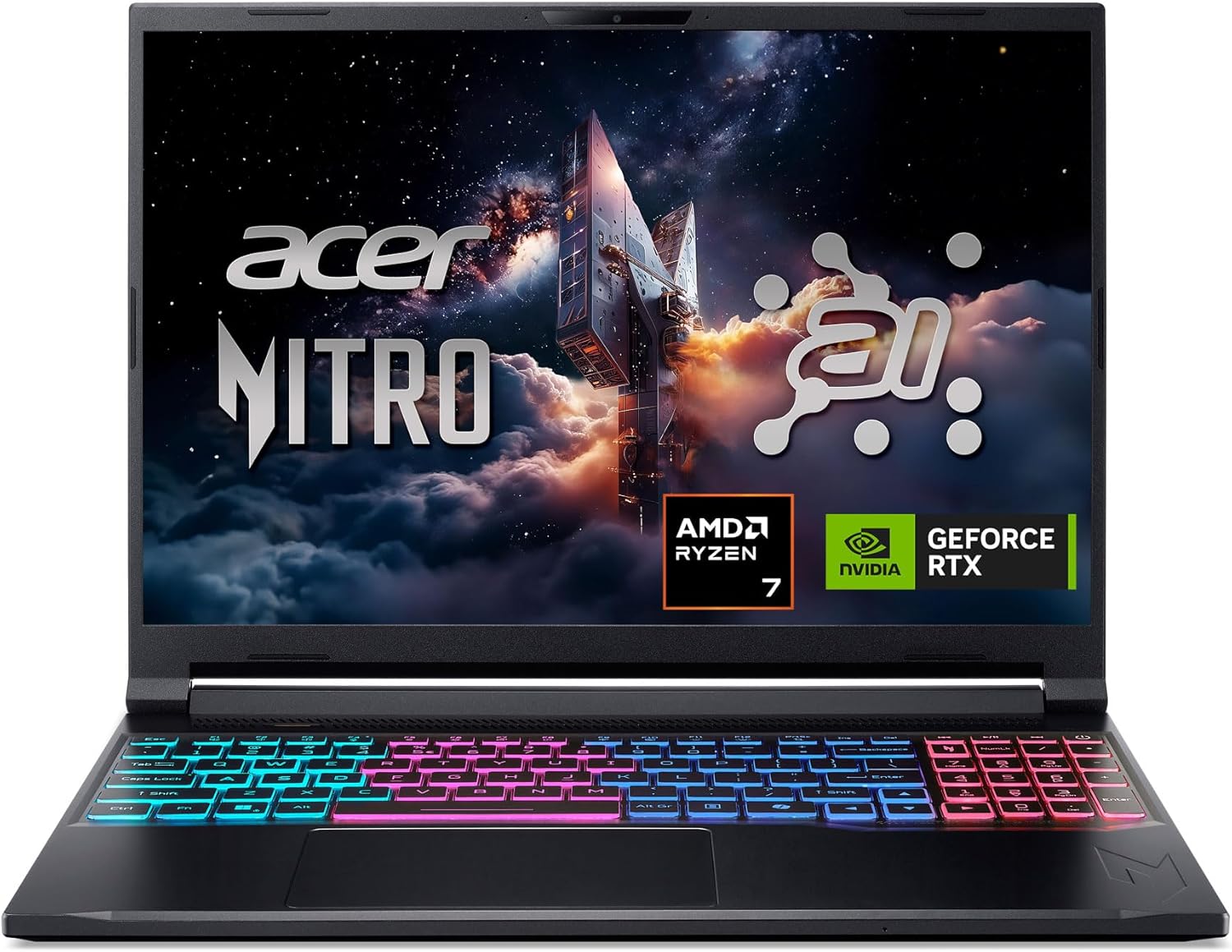
Acer Nitro V 16S
4.4/ 5
RTX 5060 GPU
4K HDR streaming
180Hz WUXGA display
32GB DDR5 memory

Choosing a 4K gaming laptop in today's market means weighing panel technology, GPU wattage, cooling design, and raw processing power against portability and price. We compare ten standout notebooks spanning RTX 5060 to RTX 5090 graphics, from ultra-slim 16-inch creators' machines to desktop-replacement 18-inch flagships built for maximum frame rates.
The term 4K covers more than resolution alone. Some models pair true UHD or UHD+ panels with OLED or MiniLED backlights, while others deliver sharp QHD+ output with higher refresh rates better suited to competitive play. Understanding which panel matches your gaming style and budget is the first step toward a satisfying long-term purchase.
To build this shortlist, we examined GPU tier and total graphics power, display resolution and refresh rate, processor generation, memory and storage configuration, cooling architecture, port selection, and build quality. Upgradeability matters too, since soldered memory limits long-term flexibility. These factors together determine whether a laptop excels at AAA single-player gaming, competitive esports, creative workflows, or a mix of all three.
4.4/ 5

4.7/ 5

3.5/ 5
As an Amazon Associate we earn from qualifying purchases, at no additional cost to you.
Swipe across to compare all columns
| Product | Key highlights | Rating | Explore |
|---|---|---|---|

Best for QHD esports
ASUS ROG Strix G16 275HX
|
RTX 5070 Ti GPU
2.5K 240Hz display
Intel Ultra 9 275HX
32GB DDR5 memory
|
4.3/ 5 | Check Price |
|
Premium pick
MSI Titan 18 HX
|
RTX 5090 GPU
18-inch MiniLED UHD+
64GB DDR5 memory
4TB NVMe SSD
|
3.5/ 5 | Check Price |
|
Best value
Acer Nitro V 16S
|
RTX 5060 GPU
180Hz WUXGA IPS
Ryzen 7 260 CPU
32GB DDR5 memory
|
4.4/ 5 | Check Price |

Best for creators
Dell XPS 16
|
RTX 5060 GPU
4K 120Hz touchscreen
Intel Ultra 9 285H
32GB DDR5 memory
|
5.0/ 5 | Check Price |

Best value
ASUS ROG Strix G16 14650HX
|
RTX 5060 GPU
165Hz FHD+ display
Intel Core i7 14650HX
16GB DDR5 memory
|
4.4/ 5 | Check Price |

Best for AMD enthusiasts
ASUS ROG Strix G18
|
RTX 5070 GPU
18-inch 2.5K 240Hz
AMD Ryzen 9 9955HX
Nebula WQXGA panel
|
5.0/ 5 | Check Price |

Best for OLED gaming
MSI Stealth 16
|
RTX 5070 Ti GPU
240Hz QHD+ OLED
Intel Ultra 9 386H
32GB DDR5 memory
|
4.3/ 5 | Check Price |

Best for storage capacity
MSI Crosshair 18 HX
|
RTX 5070 GPU
18-inch 240Hz display
Intel Ultra 9 275HX
2TB NVMe SSD
|
5.0/ 5 | Check Price |
|
Best overall
ASUS ROG Strix G16 2026
|
RTX 5080 GPU
Nebula HDR 2.5K
Intel Ultra 9 290HX
Tool-free upgrade access
|
4.7/ 5 | Check Price |

Best for 4K OLED work
Dell Premium 16
|
4K OLED touchscreen
Intel Ultra 7 255H
32GB LPDDR5X memory
RTX 5050 GPU
|
4.6/ 5 | Check Price |
As an Amazon Associate we earn from qualifying purchases, at no additional cost to you.
The ASUS ROG Strix G16 with the Intel Core Ultra 9 275HX and RTX 5070 Ti is built for players who want high frame rates at QHD+ resolution before considering true 4K output. The 2.5K 240Hz Nebula panel delivers a responsive, sharp image that balances pixel density and competitive refresh rates, making it a flexible choice for mixed gaming libraries.
The RTX 5070 Ti with Blackwell architecture adds DLSS 4 and Max-Q technologies, which help maintain playable frame rates when you connect the laptop to a 4K external monitor for cinematic single-player sessions. For native-panel gaming, the 2.5K resolution lets the GPU stretch further into high settings than a UHD panel would allow at the same frame rate.
Thermal design is one of the strongest aspects of this model. The end-to-end vapor chamber, tri-fan layout, and Conductonaut liquid metal on the chipset help sustain clock speeds during longer sessions. Wi-Fi 7, 32GB of DDR5-5600 memory, and 1TB of PCIe Gen 4 storage round out a well-balanced configuration for both gaming and content work.
This Strix G16 suits competitive players who want ROG build quality and plan to game primarily at the native 2.5K resolution. If you specifically want a 4K native panel inside the laptop itself, consider one of the UHD or OLED models in this guide instead, since the native display here is 2.5K rather than 3840 x 2160.
Many gamers get the best of both worlds by using the internal 2.5K 240Hz panel for competitive play and connecting an external 4K monitor for story-driven titles and media. The RTX 5070 Ti has enough headroom to handle 4K at high settings in many titles with DLSS enabled, so this laptop can function well in both roles when paired with the right external display.
Buyers who want a native UHD or UHD+ panel built into the laptop should look at models like the Dell XPS 16 or MSI Titan 18 HX instead. The Strix G16 prioritizes refresh rate over raw pixel count on its internal screen, which is ideal for esports but less suited to those who specifically want 4K rendering on the laptop itself.
As an Amazon Associate we earn from qualifying purchases, at no additional cost to you.
The MSI Titan 18 HX is a desktop replacement in every sense, pairing an 18-inch 4K UHD+ MiniLED panel at 240Hz with the flagship RTX 5090 GPU. MiniLED backlighting delivers deep local dimming and strong HDR highlights, which gives the display both the resolution and contrast needed to showcase modern AAA titles at their best.
The Intel Core Ultra 9 290HX processor paired with 64GB of DDR5 memory and a 4TB NVMe SSD removes most practical bottlenecks for gaming, streaming, and demanding creative work. The 24GB of GDDR7 VRAM on the RTX 5090 is particularly useful for 4K gameplay with ray tracing enabled and for large creative projects such as high-resolution video editing or 3D rendering.
Connectivity is forward-looking, with Thunderbolt 5 and Wi-Fi 7 providing fast external storage and low-latency wireless networking. The sheer size and weight of an 18-inch chassis give engineers room for a more capable cooling system, which typically means better sustained performance than thin designs can offer, though it also means the Titan is not a practical travel laptop.
This machine is best for enthusiasts who want the most powerful portable gaming system available and plan to use it primarily on a desk. The 3.5 customer rating is worth noting and reflects a smaller review sample; buyers should weigh that against the raw hardware specifications and MSI's published Titan platform reputation.
MiniLED backlights use thousands of individually dimmable zones to approach OLED-like contrast while delivering higher peak brightness. For 4K HDR content and games, this translates into brighter highlights without sacrificing shadow detail. The tradeoff compared to OLED is that very small bright objects on dark backgrounds can show a slight halo effect, but the improved sustained brightness is a meaningful advantage in bright rooms.
If portability is important, the Titan 18 HX will be far too large and heavy for comfortable daily transport. Gamers who need to move between home and office or travel for work should look at 16-inch models like the ASUS ROG Strix G16 lineup or the MSI Stealth 16, which balance performance with a more manageable footprint.
As an Amazon Associate we earn from qualifying purchases, at no additional cost to you.
The Acer Nitro V 16S is the most accessible entry point in this guide to RTX 50-series gaming performance. The combination of an AMD Ryzen 7 260 processor and RTX 5060 GPU with 572 AI TOPS is well-suited to 1440p and WUXGA gaming with DLSS 4 enabled, and the laptop can drive 4K HDR streaming comfortably for media consumption even though the built-in panel is 1920 x 1200.
DLSS 4 with Multi Frame Generation is particularly valuable on this tier of GPU. By using AI-generated frames, the RTX 5060 can deliver smooth gameplay in supported titles at settings that would otherwise exceed the GPU's native throughput. This helps the laptop punch above its weight in modern games without requiring you to compromise on visual settings.
Upgradeability is a real advantage over soldered-memory competitors. The 32GB of DDR5-5600 memory lives in two SO-DIMM slots, and a second M.2 slot is available for additional PCIe Gen 4 storage. The 180Hz WUXGA IPS display with 100 percent sRGB coverage is responsive and color-accurate, though it does not match the resolution or contrast of the OLED and MiniLED panels elsewhere in this lineup.
This laptop is best for budget-focused gamers who want current-generation GPU performance and the flexibility to upgrade components later. If a true 4K internal display is a hard requirement for your purchase, a different model in this guide will serve you better, but for value per dollar of gaming capability, the Nitro V 16S is hard to beat.
It is worth distinguishing 4K video streaming from 4K game rendering. This laptop can decode and play 4K HDR video from streaming services on its WUXGA display or on an external 4K monitor without issue. Native 4K game rendering at high settings, however, is more demanding than the RTX 5060 is designed for. Plan to use DLSS or lower settings if you want to game at 4K on an external display.
Buyers who need maximum frame rates at 4K with ray tracing enabled should look at RTX 5080 or RTX 5090 configurations such as the ASUS ROG Strix G16 2026 or the MSI Titan 18 HX. The RTX 5060 is excellent for 1080p and 1440p gaming but is not designed to deliver uncompromised native 4K gaming performance.
As an Amazon Associate we earn from qualifying purchases, at no additional cost to you.
The Dell XPS 16 brings a native 16.3-inch UHD+ touchscreen at 3840 x 2400 to a premium ultra-portable chassis, which is a rare combination in the gaming-adjacent space. The Intel Core Ultra 9 285H processor and RTX 5060 GPU are tuned more for creator workflows and lighter gaming than for maximum frame rates, so expect to use DLSS or reduced settings when running demanding titles at native resolution.
The 120Hz refresh rate is high enough to feel smooth for most single-player games and productivity tasks, but competitive esports players who are accustomed to 240Hz panels will notice the difference. For color-critical work such as photo and video editing, the 4K resolution combined with a 400-nit panel provides a detailed canvas that rewards creative software.
Connectivity is a standout, with three Thunderbolt 4 ports, a MicroSD card reader, Wi-Fi 7, and Bluetooth 5.4. You can drive up to three external displays via Thunderbolt and connect a wide range of professional peripherals without dongles. Windows 11 Pro is included, which adds enterprise features such as BitLocker and Remote Desktop that business users appreciate.
This laptop is best for creative professionals, developers, and business users who want a premium 4K-capable machine that can also handle gaming when the workday ends. Dedicated gamers who prioritize high frame rates and higher-tier GPUs will find this configuration limiting; the XPS 16 is a creator laptop that happens to game competently rather than a pure gaming machine.
The UHD+ resolution and 16:10 aspect ratio give creators a large working area for timelines in video editors, multiple panels in Photoshop, and side-by-side code windows in development environments. The touchscreen and haptic touchpad also support stylus workflows and gesture-based navigation, which is useful for illustrators, UX designers, and anyone who annotates documents.
Hardcore gamers who want the highest possible frame rates in AAA titles at native 4K should look at the RTX 5080 or RTX 5090 models in this guide. The combination of an RTX 5060 and a 4K panel means you will frequently need DLSS or lower settings to maintain smooth performance in demanding games.
As an Amazon Associate we earn from qualifying purchases, at no additional cost to you.
This ASUS ROG Strix G16 configuration delivers the Strix design language and cooling at a more approachable price by pairing a 14th-gen Intel Core i7 14650HX with the RTX 5060 GPU. The 165Hz FHD+ panel keeps motion crisp for most games, and the RTX 5060 is well-matched to the native resolution, meaning fewer compromises in settings than higher-resolution panels would require at this GPU tier.
ROG Intelligent Cooling with an end-to-end vapor chamber, tri-fan technology, and Conductonaut liquid metal on the chipset is shared across the Strix lineup. That means this more affordable Strix benefits from the same thermal engineering as its pricier siblings, which helps sustain clock speeds during longer sessions and maintains more consistent frame rates in extended play.
The 16GB of DDR5-5600 memory is adequate for current gaming but can feel tight when streaming, running voice chat, and keeping a browser open simultaneously. The 1TB PCIe Gen 4 SSD provides reasonable space for a modern game library, though gamers with large libraries may want to budget for additional storage or external drives.
This Strix G16 variant is best for gamers who want ROG build quality and cooling without stretching into higher GPU or memory tiers. If your library includes memory-hungry sim games or you plan to stream regularly, consider stepping up to a 32GB configuration rather than relying on the 16GB this model ships with.
A sharp FHD+ panel at 165Hz lets the RTX 5060 run most modern games at high settings without needing aggressive DLSS use. For competitive titles and fast-paced action games, the combination of frame rate and matched resolution often provides a more consistent experience than a higher-resolution panel starved for GPU power. It also lets the laptop drive external 1440p or 4K displays when you want to stretch into bigger screens.
If you need a native 4K or 2.5K panel on the laptop itself or want to future-proof with 32GB of memory, this configuration is a compromise. Buyers in that position should consider the Strix G16 with the Intel Ultra 9 275HX or the 2026 Strix G16 with the RTX 5080, both of which offer higher-resolution panels and more memory.
As an Amazon Associate we earn from qualifying purchases, at no additional cost to you.
The ASUS ROG Strix G18 takes the Strix formula into a larger 18-inch 2.5K form factor powered by the AMD Ryzen 9 9955HX processor with 16 cores and 32 threads. The combination of a large WQXGA 240Hz Nebula panel with G-SYNC and Pantone Validation makes it appealing both for gaming and for creative tasks that need wide color coverage.
The RTX 5070 GPU with 8GB of GDDR7 memory and up to 115W ROG Boost is well-matched to the 2560 x 1600 native resolution. For games that scale well with DLSS, this configuration can push closer to 4K output on an external monitor while retaining comfortable frame rates on the built-in panel for everyday play.
Upgradeability is a notable strength. The two SO-DIMM slots support DDR5 memory up to 64GB, and two M.2 slots provide PCIe Gen 4 SSD expansion. Connectivity includes HDMI 2.1 for 4K output to external displays, two USB 3.2 Gen 2 Type-A ports, and a 3.5mm combo audio jack. Aura Sync lighting and an integrated light bar add the signature ROG aesthetic.
This Strix G18 is best for AMD enthusiasts who want a large screen for immersive gaming and content creation without moving to the weight class of an 18-inch RTX 5090 flagship. If true native 4K on the laptop is a priority, a UHD or UHD+ panel from Dell or MSI will be a closer match to that specific requirement.
Having access to two SO-DIMM slots and two M.2 slots means this laptop can grow with your needs. Starting with the factory configuration and later upgrading to 64GB of memory or adding a second SSD is a practical way to extend the useful life of the machine. Review the official ASUS service documentation before attempting upgrades to understand warranty implications and the specific memory speeds supported.
Gamers set on Intel processors or on a native 4K panel should look at other models in this guide. The 2.5K Nebula panel is excellent, but it is not UHD, and the AMD CPU, while powerful, will not suit buyers who specifically want Intel's platform features such as Thunderbolt.
As an Amazon Associate we earn from qualifying purchases, at no additional cost to you.
The MSI Stealth 16 AI+ pairs a 240Hz QHD+ OLED panel with the Intel Core Ultra 9 386H processor and the RTX 5070 Ti GPU inside a restrained charcoal black chassis. For gamers who want OLED contrast and fast refresh without advertising the machine as a gaming laptop in professional settings, this is one of the more appealing designs in the category.
The RTX 5070 Ti in this configuration features 16GB of GDDR7 VRAM, which provides meaningful headroom for 1440p and 4K gaming on an external monitor, especially when DLSS 4 is enabled. The extra VRAM is also valuable for creative workflows that handle large textures, 3D assets, or high-resolution video.
Everyday usability benefits from Wi-Fi 7 for fast wireless downloads and Windows 11 Home preinstalled, with the option to upgrade to Pro for business features. The tradeoff of the Stealth form factor is that thin chassis designs typically sustain lower GPU wattage than thicker performance-focused rivals, so expect measured rather than maximum sustained clock speeds in long sessions.
This laptop is best for gamers and creators who want the visual qualities of an OLED panel with strong GPU performance and a design that blends into the office. Buyers who want a native 4K panel on the laptop itself or the absolute highest sustained GPU power should look at larger models elsewhere in this guide.
OLED displays produce true blacks because each pixel can turn off completely. This gives games and movies a cinematic depth that IPS panels cannot match, and the fast pixel response time reduces motion blur. For creative work such as photo editing, the wide color coverage typical of OLED panels helps with accurate color grading, though static UI elements at full brightness for very long periods should be avoided to minimize burn-in risk.
If a native 4K panel is essential, the QHD+ resolution here will fall short of that specific requirement. Buyers in that case should look at the Dell XPS 16, the Dell Premium 16 OLED, or the MSI Titan 18 HX, which all offer native UHD or UHD+ panels.
As an Amazon Associate we earn from qualifying purchases, at no additional cost to you.
The MSI Crosshair 18 HX offers an 18-inch 2560 x 1600 IPS panel at 240Hz, which gives it one of the larger high-refresh gaming displays available in a laptop. The combination of the Intel Core Ultra 9 275HX processor with 24 cores and the RTX 5070 GPU with 8GB of GDDR7 memory is a balanced pairing for QHD+ gaming at high settings.
Storage is a standout feature. The 2TB NVMe SSD provides room for a sizeable modern game library without immediately needing an external drive, and the fast access times keep load screens brief. The 32GB of DDR5-5600 memory handles multitasking between gaming, streaming, and content creation applications without issue.
For audio, dual Dynaudio 2W speakers paired with dual 2W woofers deliver fuller sound than typical laptop setups, which is useful for immersive single-player games and media consumption when a headset is not practical. Wi-Fi 6E and Bluetooth 5.3 round out connectivity, though Wi-Fi 7 remains reserved for other models in this guide.
This Crosshair is best for gamers who want a large 240Hz display and generous built-in storage in a single purchase. Buyers who prioritize the newest wireless standards or a native 4K panel should look at alternative models, since this machine opts for high-refresh QHD+ and current-generation Wi-Fi rather than bleeding-edge wireless.
Modern AAA games routinely occupy 100 to 200GB on disk, and a handful of installed titles can fill a 1TB drive quickly. Starting with 2TB gives you room for a larger active library, multiple creative project files, and system backups without immediately turning to external storage. If you install frequently and want to avoid shuffling games on and off the drive, the extra capacity is a tangible quality-of-life benefit.
If Wi-Fi 7 or native 4K display are important to you, this model will fall short on those specific requirements. Buyers in that position should consider the Dell XPS 16 for 4K or the ASUS ROG Strix G16 2026 for Wi-Fi 7 and a higher-tier GPU.
As an Amazon Associate we earn from qualifying purchases, at no additional cost to you.
The 2026 ASUS ROG Strix G16 steps up to the RTX 5080 GPU and the Intel Core Ultra 9 290HX Plus processor, delivering one of the most capable 16-inch configurations in this guide. The Nebula HDR 2.5K panel adds Dolby Vision HDR, AGLR anti-glare treatment, and improved contrast, which together make the display a strong match for both competitive and cinematic play.
The RTX 5080 provides significant performance headroom over the RTX 5070 Ti and RTX 5070 configurations elsewhere in this guide, especially when driving 4K output to an external monitor with ray tracing enabled. The MUX Switch with Advanced Optimus routes frames directly from the discrete GPU for a 5 to 10 percent performance gain in gaming, while still allowing the laptop to switch to the integrated GPU for longer battery life during lighter work.
Serviceability is unusual for the category. A tool-free latch on the bottom of the chassis provides access to the RAM, SSD, and fans, which makes future upgrades and cleaning much easier than on sealed designs. Thermal design continues to feature an end-to-end vapor chamber, tri-fan layout, and Conductonaut liquid metal on the chipset.
This laptop is the strongest all-around choice in this guide for gamers who want flagship-tier performance in a 16-inch chassis with room to grow. Buyers who specifically require an internal UHD or UHD+ panel will want to compare it against the Dell XPS 16 or MSI Titan 18 HX, but for most players seeking a balance of frame rate, image quality, and portability, this model is hard to beat.
A MUX Switch lets the system route graphics output directly from the discrete GPU to the display, bypassing the integrated GPU. This small architectural change can meaningfully improve gaming performance because it removes a rendering step. Advanced Optimus takes this further by automatically choosing the right GPU for the task, which preserves the performance benefit for gaming while improving battery life for office and media work.
If a native 4K internal display is essential for your workflow, the 2.5K Nebula panel on this model is not that. Shoppers with that specific requirement should consider the Dell XPS 16, Dell Premium 16 OLED, or the MSI Titan 18 HX, which all provide native UHD-class panels.
As an Amazon Associate we earn from qualifying purchases, at no additional cost to you.
The Dell Premium 16 delivers a 16.3-inch 4K OLED touchscreen at 3840 x 2400 with a 120Hz refresh rate, which is one of the most visually impressive panels in this guide. The combination of OLED contrast, 4K resolution, and touch input makes it particularly appealing for creative professionals who want a cinematic display and occasional gaming rather than a pure gaming machine.
The product title lists an Intel Core Ultra 7 255H processor paired with the RTX 5050 GPU, while the expanded details reference an Intel Ultra 9 285H with the RTX 5060. Variance of this kind is common when a retailer listing covers multiple configurations, so buyers should verify the exact processor and GPU tier at checkout to avoid surprises. Either way, the GPU here is tuned for creative work and light gaming rather than maximum frame rates at 4K.
Supporting hardware is strong. The 32GB of LPDDR5X memory is efficient and plentiful, the 1TB PCIe NVMe SSD is quick, and the 99Whr battery supports longer work sessions than most gaming laptops. Three Thunderbolt 4 ports, an SD card reader, Wi-Fi 7, and Bluetooth 5.4 cover professional connectivity needs, and Windows 11 Pro includes enterprise features.
This laptop suits creators and professionals who want the visual quality of a 4K OLED display and the premium build of the Dell Premium line, with gaming as a secondary use. Gamers focused on maximum frame rates in AAA titles should look elsewhere, since the RTX 5050 or 5060 is not designed to drive native 4K gaming at high settings without substantial DLSS assistance.
Because the listing mixes Ultra 7 and Ultra 9 processors as well as RTX 5050 and RTX 5060 GPUs, confirm the specific model code and specification sheet before purchase. Ask the seller or check the invoice to confirm which processor and GPU you are receiving, since the practical gaming experience varies between the tiers even though the external chassis and display are the same.
Buyers who want to game at native 4K with ray tracing and high settings should look at the MSI Titan 18 HX with its RTX 5090 or the ASUS ROG Strix G16 2026 with its RTX 5080. The Premium 16 is a creator-first laptop with a stunning display, and its GPU tier reflects that focus rather than a competitive gaming mandate.
As an Amazon Associate we earn from qualifying purchases, at no additional cost to you.
A 4K gaming laptop blends high-resolution visuals with significant GPU horsepower, but the right choice depends on how you weigh resolution, refresh rate, cooling, memory, and portability. This guide walks through the decisions that most affect your day-to-day experience.
4K at 3840 x 2160 and UHD+ at 3840 x 2400 are the highest resolutions commonly offered in gaming laptops, and they are not the only panels worth considering. Many high-performance notebooks ship with QHD+ 2560 x 1600 panels that push refresh rates to 240Hz and above, which can feel smoother in fast-paced games than a lower-refresh 4K panel. Decide whether you prioritize pixel density for still detail and creative work or refresh rate for competitive responsiveness.
Panel technology also shapes the experience. OLED panels deliver perfect blacks and vivid colors but should be managed to reduce burn-in risk from static images. MiniLED backlights use thousands of dimming zones for very high brightness and strong HDR performance with less burn-in concern. IPS panels remain cost-effective and offer wide viewing angles with good color coverage. Each technology has tradeoffs that matter more or less depending on your gaming and work habits.
If immersive single-player gaming and media are your focus, a UHD OLED or MiniLED panel is a strong match. If competitive multiplayer dominates your library, a 2.5K panel at 240Hz often serves better. Many buyers successfully combine a 2.5K internal panel with an external 4K monitor for cinematic play at the desk.
The GPU is the single most important component for 4K gaming performance, and the RTX 50-series spans a wide range. The RTX 5060 and RTX 5070 handle 1440p and WUXGA gaming well, the RTX 5070 Ti and RTX 5080 open up comfortable 4K play with DLSS enabled, and the RTX 5090 is the clear choice for maximum settings at 4K with ray tracing. VRAM also varies, from 8GB on lower tiers to 16GB and 24GB on higher tiers, which affects how much headroom you have for high-resolution textures and future titles.
Total Graphics Power, often shortened to TGP, determines how many watts the GPU can draw inside the laptop. A thin chassis may run an RTX 5070 Ti at a lower TGP than a thicker performance-focused machine with the same GPU, and the difference can be visible in sustained frame rates. When comparing two laptops with the same GPU model, check the published TGP figure rather than assuming the chips perform identically.
For 4K gaming aspirations, prioritize the RTX 5070 Ti, 5080, or 5090 tiers and match them to a chassis with the cooling capacity to sustain performance. For 1440p and WUXGA gaming at high settings, the RTX 5060 and 5070 offer strong value, especially when paired with DLSS 4 Multi Frame Generation.
Modern Intel Core Ultra 9 and AMD Ryzen 9 processors in this category offer 16 to 24 cores with boost clocks above 5GHz. For pure gaming the GPU is usually the bottleneck, but the CPU matters more in large multiplayer titles, simulation games, streaming while gaming, and creative workflows. Intel's newer Ultra 9 chips with AI acceleration also benefit workflows that use DLSS and AI upscaling, while AMD Ryzen 9 chips are known for strong multi-threaded performance.
Memory capacity and type significantly influence long-term usability. 16GB has become the current minimum for gaming comfort, 32GB handles most multitasking and content creation, and 64GB is aimed at professionals working with large datasets, complex 3D scenes, or many virtual machines. Soldered LPDDR5X memory cannot be upgraded after purchase, so choose the capacity you need from the start. Socketed DDR5 memory in SO-DIMM slots allows upgrades later.
If you plan to keep the laptop for several years and use it for both gaming and productivity, 32GB is the practical sweet spot. If memory upgradeability matters, confirm whether the model you want uses soldered memory or SO-DIMM slots before ordering.
A gaming laptop's cooling system determines how long it can maintain peak clock speeds before thermal throttling kicks in. Vapor chambers, multiple fans, liquid metal thermal compound, and generous heatpipe arrays all contribute to sustained performance. Thinner laptops with small coolers can hit high boost clocks briefly but may throttle under extended loads, while larger chassis with more surface area tend to hold higher sustained clocks.
Published TGP figures and total system power ratings help you compare sustained performance potential. A laptop rated for 300W total system power will sustain higher combined CPU and GPU loads than one rated for 200W. Features such as liquid metal on the chipset, tool-free access for cleaning, and multi-mode thermal profiles help both initial performance and long-term reliability.
If you game for several hours at a time or live in a warm climate, prioritize cooling capacity over raw thinness. For portable use with shorter sessions, a thinner chassis with efficient cooling may deliver a better overall balance of performance and daily usability.
Refresh rate, response time, color coverage, and HDR capabilities all shape the gaming experience alongside resolution. A 240Hz 2.5K panel typically feels faster than a 60Hz 4K panel, even though the latter has more pixels. Response times of 3ms or less reduce motion blur in competitive play, and features such as G-SYNC and FreeSync reduce screen tearing when frame rates fluctuate. Dolby Vision HDR and VESA DisplayHDR certifications indicate stronger brightness and contrast for HDR content.
Color coverage matters for creative work. 100 percent sRGB is sufficient for everyday use, 100 percent DCI-P3 is important for video and photo editing, and Pantone Validation signals factory calibration suited to professional workflows. Anti-glare coatings and brightness levels above 400 nits help in bright rooms, while OLED panels excel in controlled lighting thanks to deep blacks and vivid color.
If you edit photos or video, prioritize a factory-calibrated panel with wide color coverage. If you game in bright environments, higher brightness and matte or AGLR anti-glare coatings reduce reflections and eye strain.
Current premium laptops offer a range of connectivity options that affect both gaming and productivity. Thunderbolt 5 and Thunderbolt 4 support fast external storage and multiple 4K displays. HDMI 2.1 is important for connecting to 4K 120Hz external monitors or TVs. Wi-Fi 7 provides the latest wireless standards, while Wi-Fi 6E remains perfectly capable for most scenarios. A wired Ethernet port, available on some larger models, offers the lowest latency for competitive multiplayer.
Storage considerations go beyond the initial capacity. A 1TB NVMe SSD fills quickly with modern AAA titles, so 2TB or 4TB configurations offer more breathing room for gamers with large libraries. Multiple M.2 slots allow future expansion. For buyers who move large creative files, SD card readers and MicroSD readers are convenient additions. Battery capacity measured in Whr indicates how long the laptop runs unplugged for productivity tasks, though expect battery gaming sessions to be short regardless of capacity.
Match connectivity and storage to your workflow. If you use external drives and multi-monitor setups, Thunderbolt and HDMI 2.1 matter. If you install many games and creative projects, prioritize larger SSDs or multiple M.2 slots for expansion.
Chassis size and weight have a direct impact on how often you actually use the laptop away from a desk. A 16-inch machine around 2 to 2.5 kg can realistically travel in a backpack, while an 18-inch desktop replacement is best left in one place. Build materials matter for durability, with CNC aluminum offering a premium feel and better rigidity than typical plastic constructions.
Upgradeability extends useful life. Models with tool-free access, SO-DIMM memory slots, and multiple M.2 bays let you add memory and storage over time. Laptops with soldered LPDDR5X memory are generally thinner and more efficient but lock you into the capacity you purchase. Keyboard quality, speaker systems, and RGB customization also affect daily enjoyment, even though they rarely appear in spec comparisons.
If you travel or commute, prioritize a lighter 16-inch chassis with good build quality. If the laptop will mostly sit on a desk and you want long-term flexibility, consider a larger model with upgradeable memory and storage to maximize longevity.
After unboxing, update Windows, GPU drivers, and the manufacturer's control software such as Armoury Crate or MSI Center. These utilities expose thermal profiles, fan curves, keyboard lighting, and MUX Switch settings that have a meaningful impact on performance and battery life. Set a high-performance profile for gaming on AC power and a balanced or quiet profile for productivity to reduce fan noise and extend battery runtime.
If your laptop has an OLED panel, enable the built-in pixel-shift and screen-saver features to reduce long-term burn-in risk. Avoid leaving static UI elements at maximum brightness for extended periods, and consider hiding the taskbar automatically to reduce persistent static content. For MiniLED and IPS panels, these precautions are less critical, but keeping brightness at reasonable levels helps extend backlight life and reduces eye strain.
Keep air vents clear by using the laptop on a hard, flat surface rather than on fabric. Periodically use compressed air to clean dust from the intake grilles and exhaust vents, which helps sustain cooling performance over time. If your laptop offers tool-free access to internal components, follow the manufacturer's instructions to inspect and clean fans every 6 to 12 months. Store the machine in a cool, dry place when not in use, and avoid prolonged exposure to high temperatures or direct sunlight.
The RTX 5080 and RTX 5090 can handle many modern titles at native 4K with ray tracing when DLSS is enabled, while the RTX 5070 Ti is capable in many games with DLSS 4 Multi Frame Generation. The RTX 5060 and RTX 5070 are better suited to QHD+ native gaming with 4K external output using aggressive DLSS settings. Match the GPU tier to the resolution and settings you expect to play at.
It depends on your priorities. A 4K panel offers more pixel density for still detail and creative work, while a QHD+ 240Hz panel delivers smoother motion for competitive gaming. For single-player AAA titles and content creation, 4K panels are compelling. For esports and fast-paced multiplayer, high-refresh QHD+ is often the better choice. Many buyers compromise by using a 2.5K internal panel with an external 4K monitor at the desk.
16GB is the current minimum for comfortable gaming but can feel tight when streaming or multitasking. 32GB is the practical sweet spot for most gamers and creators, providing headroom for background apps, voice chat, and content creation tools. 64GB is aimed at professionals working with large datasets, complex 3D scenes, or many virtual machines. If your laptop uses soldered LPDDR5X memory, choose carefully, since you cannot upgrade later.
Modern OLED panels include pixel-shift and refresh technologies that significantly reduce burn-in risk compared to earlier generations. Burn-in becomes a concern mainly when very bright static elements remain on screen for very long periods. Enabling built-in protections, hiding the taskbar automatically, and keeping brightness moderate for everyday work are practical precautions that help OLED panels last for years of mixed use.
DLSS 4 is NVIDIA's latest neural rendering suite, including Multi Frame Generation and improved Ray Reconstruction and Super Resolution. It uses AI to boost frame rates and reduce latency while maintaining image quality. For 4K gaming on laptop GPUs, DLSS 4 is particularly valuable because it lets lower-tier GPUs reach playable frame rates at higher resolutions that would otherwise require much more powerful hardware.
Cooling determines how long the laptop can sustain its peak clock speeds under load. Features like vapor chambers, tri-fan designs, and liquid metal thermal compound help maintain performance during long sessions. Thinner laptops may hit high boost clocks briefly but throttle sooner than thicker performance-focused machines. If you game for hours at a time or live in a warm climate, prioritize cooling capacity over raw thinness.
It depends on the model. Laptops with soldered LPDDR5X memory, such as thin ultraportable designs, cannot have their RAM upgraded. Models with SO-DIMM DDR5 slots, like the ASUS ROG Strix G18 and Acer Nitro V 16S, allow memory upgrades. Most laptops in this category offer at least one additional M.2 slot for SSD expansion. Check the specific model's service documentation before relying on upgradeability.
Thunderbolt 5 is a future-looking convenience rather than a requirement for gaming. It supports faster external storage and multiple 4K display connections, which is useful for creators and power users. Thunderbolt 4 remains perfectly capable for most external devices, and HDMI 2.1 handles 4K 120Hz external monitors well. Choose Thunderbolt 5 if you plan to use high-bandwidth external hardware or future-proof for the next few years.
Both platforms offer excellent gaming performance in this category. Intel Core Ultra 9 processors include strong AI acceleration and broad platform support including Thunderbolt. AMD Ryzen 9 chips are known for excellent multi-threaded performance and efficient power use. For pure gaming, the GPU matters far more than the CPU vendor. Choose based on specific features you need, such as Thunderbolt availability or particular productivity workloads.
The ASUS ROG Strix G16 2026 with the RTX 5080 and Nebula HDR panel stands out as the strongest overall choice for most buyers in this guide. It combines flagship-tier GPU power with a high-refresh 2.5K HDR display, a MUX Switch for maximum gaming performance, and tool-free access for future upgrades. For gamers who want an external 4K monitor experience plus a top-tier internal panel, this machine strikes an excellent balance between portability and raw performance.
For buyers with different priorities, several alternatives stand out. The MSI Titan 18 HX is the pick for enthusiasts who want a native 4K MiniLED panel and the RTX 5090 in one chassis. The Dell XPS 16 appeals to creators who want a native 4K touchscreen in a premium portable design. The Acer Nitro V 16S offers the most accessible entry to RTX 50-series gaming with upgradeable memory. The MSI Stealth 16 brings OLED contrast to a restrained design, and the ASUS ROG Strix G18 serves AMD fans who want a large screen.
Your best choice ultimately depends on where you play and what you play. If native 4K on the laptop is essential, choose a UHD or UHD+ panel model. If high refresh rates matter more for competitive gaming, a 2.5K 240Hz panel will feel faster. Match the GPU tier to your target resolution and settings, pick a memory configuration that meets your multitasking needs, and consider cooling and upgradeability if you plan to keep the machine for many years. Any of these ten laptops will deliver a capable 4K-ready experience; the right one is the one that aligns with your specific priorities and budget.