

MSI Crosshair 18 HX AI
5.0/ 5
Core Ultra 9 275HX
RTX 5070 8GB GDDR7
18-inch 240Hz QHD+
2TB NVMe storage
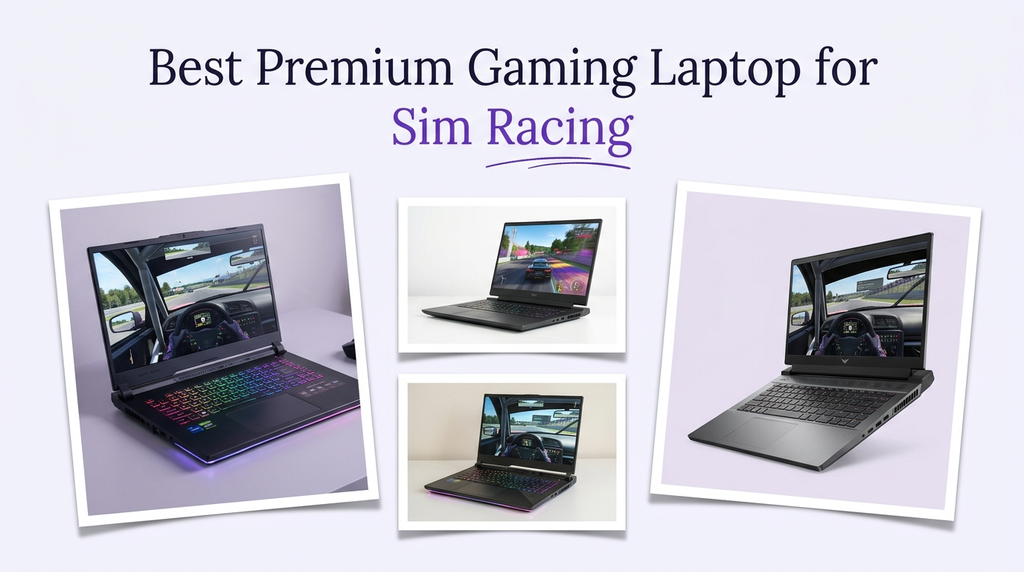
Sim racing puts unusual demands on a laptop: stable frame rates, a large high-refresh display and enough ports for a wheel, pedals and a monitor all matter. We compare 10 premium machines by GPU tier, VRAM, display, memory, storage, cooling and connectivity.
Some of these laptops carry an RTX 5090 with 24GB of VRAM, others use an RTX 5080 or RTX 5070 Ti, and a few rely on an RTX 5070 or RTX 5060. The right choice depends on your rig, whether you race on the laptop screen or an external monitor, and how much you value portability.
We compared the supplied specifications and customer ratings across these 10 models, focusing on graphics tier and VRAM, processor class, display resolution and refresh rate, memory and storage, cooling design, HDMI and USB-C display outputs, wireless connectivity and chassis size. We weighed how each configuration fits sim racing and everyday use rather than assuming the priciest option is always the best match.
5.0/ 5

4.7/ 5

As an Amazon Associate we earn from qualifying purchases, at no additional cost to you.
Swipe across to compare all columns
| Product | Key highlights | Rating | Explore |
|---|---|---|---|
|
Best value
MSI Crosshair 18 HX AI
|
Core Ultra 9 275HX
RTX 5070 8GB
18-inch 240Hz QHD+
2TB NVMe SSD
|
5.0/ 5 | Check Price |
Balanced entry option
Acer Nitro V 16S AI
|
Ryzen 7 260
RTX 5060 GPU
16-inch 180Hz
32GB DDR5
|
4.4/ 5 | Check Price |
|
Premium pick
Razer Blade 16 RTX 5070 Ti
|
Ultra 9 386H
RTX 5070 Ti
16-inch 240Hz OLED
32GB LPDDR5X
|
4.5/ 5 | Check Price |
|
Best overall
ASUS ROG Strix G16 2026
|
Ultra 9 290HX Plus
RTX 5080 GPU
16-inch 240Hz 2.5K
32GB DDR5
|
4.7/ 5 | Check Price |

Best value
ASUS ROG Strix G16 2026
|
Core i7 14650HX
RTX 5060 GPU
16-inch 165Hz
16GB DDR5
|
4.4/ 5 | Check Price |

Slim chassis option
GIGABYTE Gaming A16
|
Core i7-13620H
RTX 5060 GPU
16-inch display
Windows 11 Home
|
4.2/ 5 | Check Price |
|
Premium pick
Razer Blade 16 RTX 5090
|
Ultra 9 386H
RTX 5090 24GB
16-inch 240Hz OLED
64GB LPDDR5X
|
Not supplied | Check Price |

Best multi-core performance
ASUS ROG Strix G18 Ryzen
|
Ryzen 9 9955HX
RTX 5070 8GB
18-inch 240Hz 2.5K
Two M.2 slots
|
5.0/ 5 | Check Price |

Balanced high-refresh option
ASUS ROG Strix G16 5070 Ti
|
Ultra 9 275HX
RTX 5070 Ti
16-inch 240Hz 2.5K
32GB DDR5
|
4.3/ 5 | Check Price |

Thunderbolt 5 option
MSI Vector 16 HX AI
|
Ultra 9 275HX
RTX 5080 16GB
16-inch 240Hz QHD+
32GB DDR5
|
4.1/ 5 | Check Price |
As an Amazon Associate we earn from qualifying purchases, at no additional cost to you.
The Crosshair 18 HX AI is our Best value pick because it pairs a 24-core Core Ultra 9 275HX with an RTX 5070, 32GB of RAM and 2TB of storage behind an 18-inch QHD+ 240Hz panel. For sim racing, the large screen and processor headroom make it a strong all-round machine at a lower price than the flagship models.
The RTX 5070 with 8GB of GDDR7 handles most sim racing titles at QHD+, but 8GB of VRAM is the main caveat for triple-screen setups and high-resolution textures. The 2TB SSD gives you room for a large sim library plus recorded replays, and the 18-inch screen is useful for a single-monitor cockpit.
Cooling and connectivity benefit from the larger chassis: Wi-Fi 6E, Bluetooth 5.3, a webcam privacy shutter and a Dynaudio speaker system are included. The trade-off is weight and desk footprint, since an 18-inch laptop takes up room alongside a wheel and pedals.
This model fits sim racers who want a big screen, generous storage and 32GB of memory without paying flagship prices. If you plan to run triple monitors or the most demanding sims at maximum settings, the RTX 5080 and RTX 5090 models are the better match.
Triple-screen setups and high-resolution textures increase memory use compared with a single display. 8GB is workable for many sims, but demanding titles benefit from more VRAM, which is where the RTX 5080 and RTX 5090 models come in.
Buyers who plan to run triple monitors or the most demanding sims at high settings should consider the RTX 5080 and RTX 5090 models.
As an Amazon Associate we earn from qualifying purchases, at no additional cost to you.
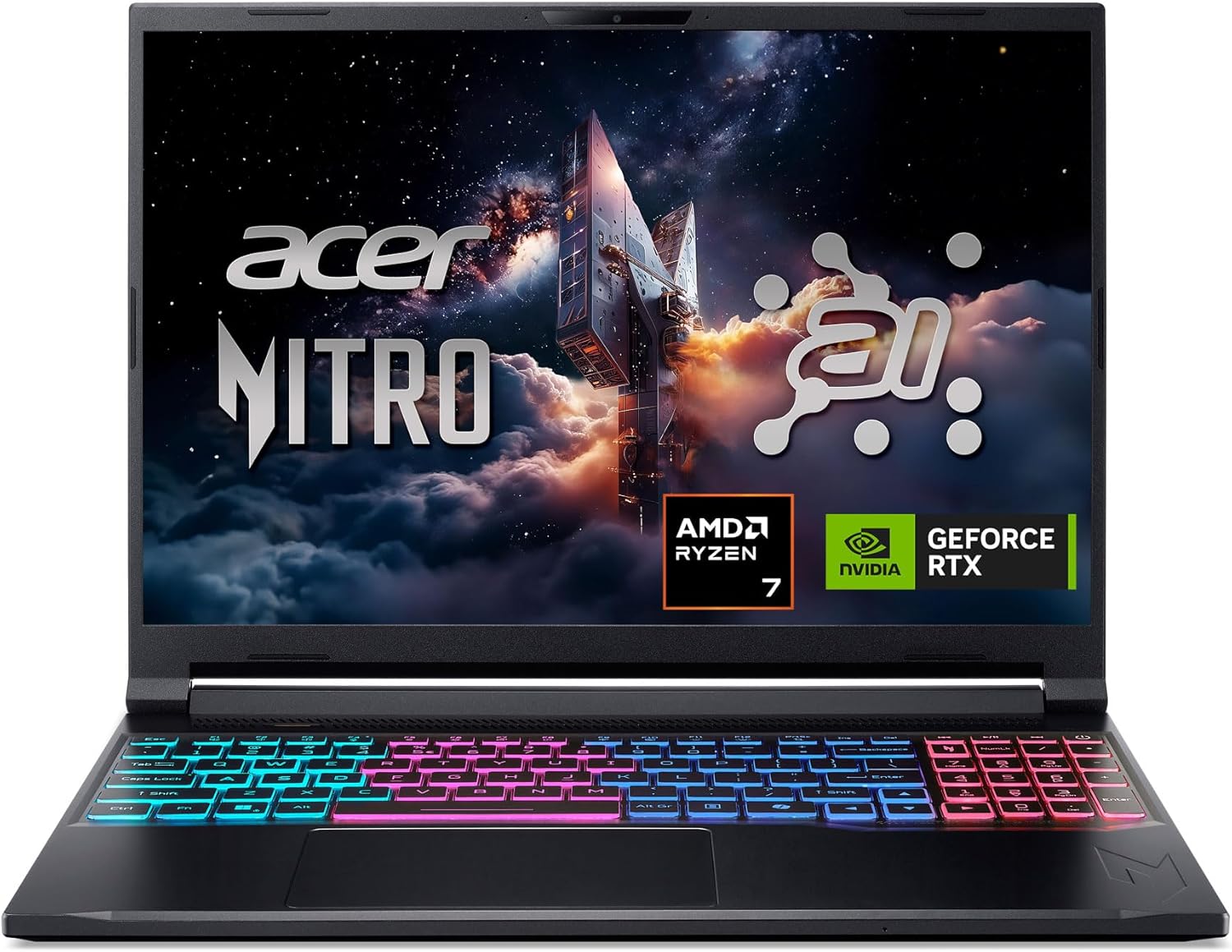
The Nitro V 16S AI is a balanced entry point for buyers who want modern gaming hardware and 32GB of memory without a flagship price. Its Ryzen 7 260 and RTX 5060 cover mainstream sim racing at moderate settings, while the 32GB of DDR5 gives headroom for a sim plus browser or telemetry apps.
The 16-inch WUXGA panel runs at 180Hz and covers 100% of the sRGB color space, which is smooth but less detailed than a QHD display. The 1TB Gen 4 SSD keeps load times short, and the chassis leaves one M.2 slot free for adding storage later.
The RTX 5060 with 8GB of VRAM is the main limitation for sim racing, especially on triple-screen setups. Wi-Fi 6 is also older than the Wi-Fi 7 found on several rivals. The pair of DDR5 slots is already occupied by the 32GB kit, which caps memory at 32GB if you follow the listed maximum.
This model fits sim racers who want a capable all-round laptop and are comfortable with moderate settings in the most demanding titles. If you want a larger screen or more VRAM, the higher-tier models are the better match.
It suits a student or home user who wants one machine for gaming, sim racing and light content creation. The 32GB memory and 1TB SSD reduce the need for immediate upgrades, while the 180Hz screen keeps single-monitor racing responsive.
Buyers who want a larger screen or more VRAM for triple-screen sim setups should look at the 18-inch models and the RTX 5080 configurations in this list.
As an Amazon Associate we earn from qualifying purchases, at no additional cost to you.
The Razer Blade 16 RTX 5070 Ti is a premium portable option that pairs a 240Hz QHD+ OLED panel with an RTX 5070 Ti, 32GB of LPDDR5X memory and a 14.9mm CNC aluminum chassis. The RTX 5070 Ti's 12GB of GDDR7 gives it more VRAM headroom than the 8GB models here, which helps with higher-resolution sim racing.
The OLED screen delivers VESA DisplayHDR TrueBlack 1000 contrast with 100% DCI-P3 coverage, making it suitable for both racing and color-critical creative work. The Intel Core Ultra 9 386H provides strong processing, and vapor chamber cooling is designed for sustained performance in the thin chassis.
Connectivity includes Wi-Fi 7, Thunderbolt 5, HDMI 2.1, USB ports and an SD card reader. The 32GB of LPDDR5X memory is fast but non-upgradeable, so buyers should treat it as a fixed configuration, and the 1TB SSD fills quickly with a large sim library.
This model fits sim racers who want a thin OLED laptop with more VRAM than the 8GB models and are prepared to pay the premium. If you need upgradeable memory or more internal storage, the ROG Strix G16 2026 and MSI Vector 16 HX AI are worth comparing.
Triple-screen setups and high-resolution textures increase memory use, so the RTX 5070 Ti's 12GB gives more headroom than 8GB models for demanding sims and higher resolutions.
Buyers who need upgradeable memory or more internal storage should compare the ROG Strix G16 2026 and the MSI Vector 16 HX AI.
As an Amazon Associate we earn from qualifying purchases, at no additional cost to you.
The 2026 ROG Strix G16 is our Best overall pick because it combines an RTX 5080, a Core Ultra 9 290HX Plus and a 2.5K Nebula HDR 240Hz display in a 16-inch chassis. For sim racing, the RTX 5080 has more VRAM headroom than the 8GB models, and the 32GB of DDR5 memory gives room for a sim plus telemetry apps.
The display uses an AGLR film to reduce glare and supports Dolby Vision HDR for better contrast in supported content. A MUX switch with Advanced Optimus can route frames directly from the discrete GPU for more performance or switch to integrated graphics for battery life without a restart.
ASUS makes upgrades easier with tool-free access to RAM, SSD and fans through a sliding latch. Wi-Fi 7 adds future-ready wireless, and the included three months of Game Pass gives new owners a way to test the machine across several genres. The 1TB storage is the main limitation for a large sim library.
This model fits sim racers who want strong graphics in a 16-inch chassis and are prepared to add storage later. If you need 2TB out of the box or an 18-inch screen, the MSI Crosshair 18 HX AI and ROG Strix G18 Ryzen are the better matches.
The RTX 5080 is a step below the RTX 5090 but above the RTX 5070 Ti in this list, making it well suited to demanding sim racing titles. The MUX switch and Advanced Optimus help balance performance and battery life.
Buyers who need 2TB of storage out of the box or an 18-inch screen should compare the MSI Crosshair 18 HX AI and the ROG Strix G18 Ryzen.
As an Amazon Associate we earn from qualifying purchases, at no additional cost to you.
The 2026 ROG Strix G16 brings the cooling design of ASUS’s premium line to an RTX 5060 configuration. Its Core i7 14650HX and 16GB of DDR5 memory cover mainstream gaming and everyday productivity, while the 16-inch FHD+ panel runs at 165Hz with a 3ms response time and an anti-glare film.
The cooling system combines an end-to-end vapor chamber, three fans and liquid metal on the chipset. That matters for longer sim racing sessions, where a simpler cooling setup might force the GPU to reduce clocks. The 1TB Gen 4 SSD is a practical size for a moderate library, and Wi-Fi 7 adds future-ready wireless.
The main trade-off for sim racing is memory: 16GB is workable for a sim plus a browser, but heavy scenes may want more. The RTX 5060's 8GB of VRAM also limits triple-screen setups and the most demanding sims. The FHD+ resolution looks less detailed than the QHD panels on the pricier models.
This model fits gamers who prioritize cooling and wireless modernity and run moderately demanding sim racing titles. If you need 32GB of memory or more VRAM, the higher-tier models are the better fit.
Sim racing sessions can run for long stretches, and a laptop that throttles mid-race disrupts the experience. The tri-fan vapor chamber design is aimed at keeping clocks steadier during extended play.
Buyers who need 32GB of memory or more VRAM for triple-screen sims should look at the ROG Strix G16 2026 or the MSI Vector 16 HX AI.
As an Amazon Associate we earn from qualifying purchases, at no additional cost to you.
The GIGABYTE Gaming A16 targets buyers who want a gaming laptop that looks and feels more like a slim everyday notebook. Its 19.45mm chassis and 180-degree lay-flat hinge make it easier to share a screen or use on uneven surfaces, while the RTX 5060 provides current-generation graphics with ray tracing and DLSS support.
The Intel Core i7-13620H is an older 13th-generation processor, so it offers less headroom than the newer Core i7 and Core Ultra chips in this list, but it is still capable for sim racing and general productivity. GIGABYTE’s GiMATE interface is designed to make system control more intuitive, though buyers should expect to spend some time learning its layout.
The slim chassis is the main practical advantage for anyone who carries a laptop daily. The trade-off is that a thinner body generally has less room for cooling than a larger gaming chassis, so sustained sim racing performance may be more limited during long sessions. The available specification detail here is also less complete than for the other models.
This model fits buyers who prioritize a slim, flexible design and modern RTX 5060 graphics over the newest processor generation. If maximum sustained sim racing performance matters most, a larger chassis is the safer choice.
A 180-degree hinge lets the screen lie flat, which is useful for sharing a display across a desk or adjusting the viewing angle in a sim rig. It is a small feature that improves everyday flexibility.
Buyers who want the newest processor generation or the most robust cooling should compare the Core i7 14650HX and Core Ultra 9 models in this list.
As an Amazon Associate we earn from qualifying purchases, at no additional cost to you.
The Razer Blade 16 RTX 5090 is our Premium pick because it pairs an RTX 5090 with 24GB of GDDR7, 64GB of LPDDR5X memory and a 2TB PCIe 4.0 SSD in a 14.9mm CNC aluminum chassis. For sim racing, the RTX 5090 has the most VRAM headroom in this list, which helps with triple-screen setups and high-resolution textures.
The 16-inch 240Hz QHD+ OLED panel delivers VESA DisplayHDR TrueBlack 1000 contrast with 100% DCI-P3 coverage, making it suitable for racing and color-critical creative work. The Intel Core Ultra 9 386H provides strong processing, and vapor chamber cooling is designed for sustained performance in the thin chassis.
Connectivity includes Wi-Fi 7, Thunderbolt 5, HDMI 2.1, USB ports and an SD card reader, with Windows Hello facial recognition for sign-in. The 64GB of LPDDR5X memory is fast but non-upgradeable, and the 2TB SSD provides more storage than the RTX 5070 Ti Blade configuration.
This model fits sim racers who want the strongest GPU and the largest storage in a thin OLED chassis and are prepared to pay the premium. If upgradeable memory matters, the MSI Vector 16 HX AI and ROG Strix G18 Ryzen are worth comparing.
More GPU memory helps when you run high-resolution textures, higher resolutions or triple-screen setups. The RTX 5090 here has the largest allocation in this list, which gives it more headroom for demanding sim racing workloads.
Buyers who need upgradeable memory or a lower price should compare the MSI Vector 16 HX AI and the ROG Strix G18 Ryzen.
As an Amazon Associate we earn from qualifying purchases, at no additional cost to you.
The ROG Strix G18 Ryzen pairs an AMD Ryzen 9 9955HX with an RTX 5070 and an 18-inch 2.5K 240Hz Nebula display. The 16-core, 32-thread processor is the most multi-core-capable chip in this comparison, which makes it a strong fit for sim racing plus telemetry apps or streaming.
The display covers 100% DCI-P3, supports G-SYNC and carries Pantone validation, so it suits color-sensitive work as well as fast games. Two SO-DIMM slots and two M.2 slots provide upgrade flexibility, with memory support up to 64GB.
One detail buyers should note is that the listing states the computer has been resealed to upgrade memory and storage, with a one-year warranty from the distributor. That is worth confirming with the seller before purchase. The RTX 5070's 8GB of VRAM is the main limit for triple-screen sim setups.
This model fits buyers who want the strongest multi-core processor, a large color-accurate screen and upgrade room. If you want more VRAM, the RTX 5080 and RTX 5090 models are the better fit.
Sixteen cores and 32 threads give the G18 more headroom for sim racing plus telemetry, streaming or running multiple demanding apps at once. Gamers who only race will see less benefit from the extra cores.
Buyers who want more VRAM or a factory-sealed configuration should compare the ROG Strix G16 2026 and the Razer Blade 16 RTX 5090.
As an Amazon Associate we earn from qualifying purchases, at no additional cost to you.
The ROG Strix G16 with the RTX 5070 Ti is a strong choice for sim racers who want high-resolution racing on a 16-inch screen. Its 2.5K Nebula display runs at 240Hz with a 3ms response time, and the RTX 5070 Ti has enough headroom for demanding sims at QHD+ or on an external monitor.
The Core Ultra 9 275HX and 32GB of DDR5 memory cover racing, streaming and creative work, while the 1TB SSD and Wi-Fi 7 round out the practical features. ROG’s cooling uses an end-to-end vapor chamber, three fans and liquid metal on the chipset, which matters for sustained sessions.
The main limitation is storage: 1TB fills quickly with a large sim library plus recorded replays, and the customer rating is slightly lower than some rivals. The 16-inch chassis also leaves less room for cooling than an 18-inch body.
This model fits sim racers who want a fast, sharp display and strong RTX 5070 Ti graphics in a 16-inch chassis. If you need 2TB of storage or an 18-inch screen, the MSI Crosshair 18 HX AI and ROG Strix G18 Ryzen are the better matches.
A 2.5K panel is easier to drive than 4K, so the RTX 5070 Ti can reach higher frame rates while still offering sharp visuals for cockpit detail and track markers.
Buyers who want more storage out of the box or a larger screen should compare the MSI Crosshair 18 HX AI and the ROG Strix G18 Ryzen.
As an Amazon Associate we earn from qualifying purchases, at no additional cost to you.
The MSI Vector 16 HX AI pairs an RTX 5080 with 16GB of GDDR7, a 24-core Core Ultra 9 275HX and 32GB of DDR5 memory behind a 16-inch QHD+ 240Hz IPS display. For sim racing, the RTX 5080's 16GB gives more VRAM headroom than the 8GB models, which helps with triple-screen setups and high-resolution textures.
The 2TB of storage would be ideal, but this configuration lists a 1TB SSD, so buyers should plan for expansion if they keep a large sim library. Dual Thunderbolt 5 ports, two USB-A 3.2 ports, HDMI 2.1, RJ45 Ethernet and an SD Express card reader provide generous connectivity for wheels, pedals and external displays.
The main caution is the customer rating, which is lower than some alternatives here. That does not identify a specific flaw by itself, but it is worth reading recent owner feedback and checking the return policy before buying. The 16-inch chassis also leaves less room for cooling than an 18-inch body.
This model fits sim racers who want RTX 5080 graphics, Thunderbolt 5 and Windows 11 Pro in a 16-inch chassis. If the highest customer satisfaction or more storage out of the box matters more, the ROG Strix G16 2026 and MSI Crosshair 18 HX AI are worth comparing.
Thunderbolt 5 supports high-speed data, external displays and docking over a single port. Two ports give you flexibility for a wheelbase, a capture device or an external monitor without swapping cables.
Buyers who want a higher customer-rated machine or 2TB of storage out of the box should compare the ROG Strix G16 2026 and the MSI Crosshair 18 HX AI.
As an Amazon Associate we earn from qualifying purchases, at no additional cost to you.
Sim racing puts different demands on a laptop than flat-screen gaming. Stable frame times, a large high-refresh display, enough VRAM for triple screens and plenty of ports for a wheel and pedals all matter. The right balance depends on your rig and how you race.
Sim racing titles can be demanding, especially with high-resolution textures, triple screens or VR. A higher-tier GPU generally supports more demanding sims at higher settings, and a higher power limit helps sustain performance during long races. In this list, the RTX 5090 sits at the top, followed by the RTX 5080, then the RTX 5070 Ti, RTX 5070 and RTX 5060.
VRAM also matters. The RTX 5090 carries 24GB, the RTX 5080 carries 16GB, the RTX 5070 Ti carries 12GB, and the RTX 5070 and RTX 5060 carry 8GB. More memory helps with triple-screen setups and high-resolution textures, but it does not make a lower-tier GPU faster on its own.
Set a target resolution and screen count first. If you race on a single QHD monitor, an RTX 5070 can be enough. If you run triple screens or a high-resolution headset, prioritize the RTX 5080 or RTX 5090 models.
The processor affects game loading, background tasks, telemetry apps and any streaming you do alongside racing. The Core Ultra 9 and Ryzen 9 chips in this list have 16 to 24 cores, which is useful for sim racing plus streaming, voice chat or running multiple applications. The Core i7 options are still capable but offer less headroom.
More cores do not automatically mean better frame rates, because most sims rely more on the GPU. However, a strong processor helps maintain smooth frame times when other apps are running. If you stream or run heavy telemetry software, the higher-core chips are worth the premium.
Choose a mid-tier processor if racing is your only task. Choose a 24-core HX chip if you stream, record or multitask heavily alongside racing.
Sim racing benefits from a large, high-refresh display because you need to read track markers and braking points at speed. An 18-inch QHD+ 240Hz panel is easier to see than a 16-inch screen, while a 16-inch 2.5K panel offers sharper detail in a more portable chassis.
Panel quality also varies. Some models here cover 100% DCI-P3 or include HDR support, which helps with color accuracy and immersion. OLED and Mini LED panels offer deeper contrast, while IPS panels are often brighter and more resistant to image retention.
Prioritize screen size if you race on the laptop display. Prioritize resolution and refresh rate if you use an external monitor. Avoid paying for a high-refresh panel if your sim cannot reach those frame rates.
16GB of RAM is the practical minimum for sim racing, but 32GB is increasingly useful because the sim, telemetry apps and any streaming or browser windows all use memory at once. Several models here ship with 32GB, and the Razer Blade 16 RTX 5090 ships with 64GB. Check whether the memory is soldered or socketed if you plan to expand.
Storage is just as important. Sim racing titles can take 50GB or more each, and a large library plus recorded replays adds up. A 1TB drive is a practical minimum and 2TB is more comfortable. Check whether the laptop has an extra M.2 slot if you plan to add storage later.
Buy as much memory and storage as you can reasonably afford at purchase. Upgrading later is possible on some models, but it adds cost and effort.
A sim rig needs ports for a wheelbase, pedals, a shifter, a button box and possibly a monitor or VR headset. Check that the laptop has enough USB-A and USB-C ports, and consider a powered USB hub if you run many accessories. An Ethernet port is useful for stable online racing.
HDMI 2.1 or DisplayPort over USB-C or Thunderbolt is useful for connecting an external monitor or triple-screen setup. Thunderbolt 4 and Thunderbolt 5 add flexibility for docking and high-speed external storage, which is useful if you record races.
Confirm the port requirements of your wheelbase and monitor before buying. Prioritize Ethernet and enough USB ports if you run a full rig, and prioritize Thunderbolt if you want a single-cable dock.
Sim races can run for a long time, so sustained cooling matters. Vapor chambers, multiple fans, liquid metal and large heat pipes are all designed to reduce throttling during long sessions. Larger chassis generally cool better than thinner ones because they have more room for airflow.
Do not judge cooling by the number of fans alone. Look for a design that covers both the CPU and GPU and has a reputation for sustained performance. The ROG models here use a tri-fan vapor chamber design, while the Razer Blade 16 uses vapor chamber cooling in a thin chassis.
If you race for hours at a time, prioritize cooling. If you only race in short sessions, a simpler cooling system may be adequate.
A premium gaming laptop for sim racing is rarely a lightweight ultrabook. The 18-inch models here are easier to see but harder to carry, while the 16-inch options are more portable. Weight, charger size and chassis thickness all affect daily portability.
Battery life is another compromise. Gaming laptops typically drain quickly under load, so plan to use the charger for racing sessions. Some models include MUX switches or Advanced Optimus to improve battery life for non-gaming tasks.
Choose a smaller model if you carry it daily. Choose a larger model if it mostly stays on a desk next to your rig and you want a bigger screen.
Warranty and seller terms vary in this category. The ROG Strix G18 Ryzen listing states the unit has been resealed to upgrade memory and storage with a distributor warranty, while other models are sold in standard configurations. Those differences affect what happens if something goes wrong.
Read the listing carefully to see who provides support and whether the configuration has been modified after leaving the factory. A lower price is less appealing if support is unclear or if the return window is short.
If service matters to you, prioritize models with clear manufacturer support. If you are comfortable with third-party configuration, verify the seller’s warranty terms before buying.
Price is not a perfect indicator of value in this category. The MSI Crosshair 18 HX AI delivers an 18-inch QHD+ 240Hz screen, 32GB of RAM and 2TB of storage for far less than the flagship models, while the Razer Blade 16 RTX 5090 adds the strongest GPU and a thin OLED chassis. Compare the whole package rather than one specification.
Upgradeability can extend lifespan. Access to RAM and storage is a plus, and a spare M.2 slot makes it easier to add capacity later. Some laptops have soldered memory, so check before assuming you can upgrade.
Set a budget and identify the one or two features you care most about. Spend on the GPU and display first, then add memory and storage if the budget allows.
Set up the laptop on a hard, flat surface so the cooling vents are not blocked. Sim racing sessions can run for a long time, so avoid using it on a bed or cushion where trapped heat can cause the fans to run louder and the components to throttle. Position the laptop so the wheel and pedal cables have room without pulling on the ports.
Keep the operating system, graphics drivers and sim racing software up to date. Many gaming laptops rely on vendor control software to switch between integrated and discrete graphics, adjust fan profiles and enable the highest refresh rate. For racing, enable the direct GPU mode if the model supports it and close unnecessary background apps to keep frame times stable.
Clean the vents regularly with compressed air and keep the laptop away from dust and pet hair. Check the manufacturer’s guidance before opening the chassis for upgrades, because some models have tool-free access while others require more care. Store the laptop in a padded sleeve when carrying it, and use a surge protector when plugged in.
A good sim racing laptop needs a capable GPU with enough VRAM, stable frame times under sustained load, a large high-refresh display and the ports for your wheel, pedals and monitor. Cooling also matters because races can run for long stretches. A higher-tier GPU generally supports more demanding sims at higher settings.
8GB is workable for a single QHD monitor at moderate settings, but triple screens and high-resolution textures benefit from more. The RTX 5070 Ti carries 12GB, the RTX 5080 carries 16GB and the RTX 5090 carries 24GB in this list. More VRAM helps with high-resolution textures and multi-screen setups.
An 18-inch screen makes track markers and braking points easier to read at speed, which helps immersion. The trade-off is size and weight. If you race on an external monitor, a 16-inch laptop may be the more portable choice.
The RTX 5090 offers the most graphics headroom in this list, which helps with triple-screen setups and demanding sims at high settings. For a single QHD monitor, an RTX 5070 or RTX 5060 can be enough. The right choice depends on your rig and how much you value future headroom.
16GB is the practical minimum, but 32GB is useful because the sim, telemetry apps and any streaming or browser windows all use memory at once. Several laptops in this list include 32GB, which gives more headroom for multitasking and future titles.
It depends on your hardware. A wheelbase, pedals, shifter and button box can each use a USB port, so check the laptop’s port count and consider a powered USB hub. An Ethernet port is also useful for stable online racing.
Yes, many gaming laptops can drive multiple external monitors through HDMI and USB-C or Thunderbolt ports, but the number and resolution depend on the model. Check the display output specifications and confirm that the GPU can handle the combined resolution at your target frame rate.
Sim racing titles can take 50GB or more each, so a 1TB SSD is a practical minimum and 2TB is more comfortable for a large library plus recorded replays. Check whether the laptop has an extra M.2 slot if you plan to add storage later.
A desktop generally offers more performance per dollar and better cooling for sim racing. Choose a desktop if you always race in one place and do not need portability. Choose a laptop if you need to move your rig or prefer an all-in-one machine.
Confirm who provides the warranty on the upgraded memory and storage, because it may be the reseller rather than the manufacturer. Ask about the return window and whether the upgraded parts are covered. If the seller’s terms are unclear, consider a factory-sealed configuration instead.
The ASUS ROG Strix G16 2026 is our Best overall choice because it combines an RTX 5080, a Core Ultra 9 290HX Plus, 32GB of DDR5 memory and a 2.5K Nebula HDR 240Hz display in a 16-inch chassis. For sim racing, it offers strong graphics headroom and a sharp, fast screen without the price of the RTX 5090 models.
The MSI Crosshair 18 HX AI is the Best value pick for shoppers who want an 18-inch QHD+ screen, 32GB of RAM and 2TB of storage at a lower price. The Razer Blade 16 RTX 5090 is the Premium pick for those who want the strongest GPU and a thin OLED chassis. The ROG Strix G18 Ryzen is a strong alternative for multi-core performance and upgrade room.
Your final decision should come down to your rig, your sims and how much you value portability. Prioritize GPU power and VRAM for triple screens, the display size for immersion, and the ports for your wheel and pedals. Matching those priorities to your budget will lead you to the right machine.