

CyberPowerPC i7-14700F
4.3/ 5
Ryzen 7 8700F processor
RTX 5060 Ti 8GB
16GB DDR5 memory
1TB NVMe SSD

Modded games ask more of a PC than their vanilla versions, sometimes by a wide margin. Texture overhauls, high-poly meshes, script-heavy mod packs, and sprawling object counts all add CPU and memory pressure on top of what the base game already demands. A desktop built for heavy modding needs processor headroom, plenty of RAM, graphics memory, and fast storage rather than just a strong GPU.
The practical result of a mismatched machine is familiar to modders: long load screens, stutter when new assets stream in, and a frame rate that dips in crowded scenes. Mod lists can also grow over time, so a desktop that feels fine with a light loadout may struggle once you add a few more layers. Picking a machine with room to absorb that growth is often smarter than buying for your current setup alone.
To build this guide, we compared the listed specifications and customer ratings across all ten desktops. We looked at processor core counts and clock speeds, graphics card tier and video memory, memory capacity and speed, SSD size and type, cooling design, power supply, and USB and wireless connectivity. We weighed those factors against the practical realities of running large mod lists rather than ranking by price. The recommendations reflect specification-based reasoning, not measured test results.
4.3/ 5
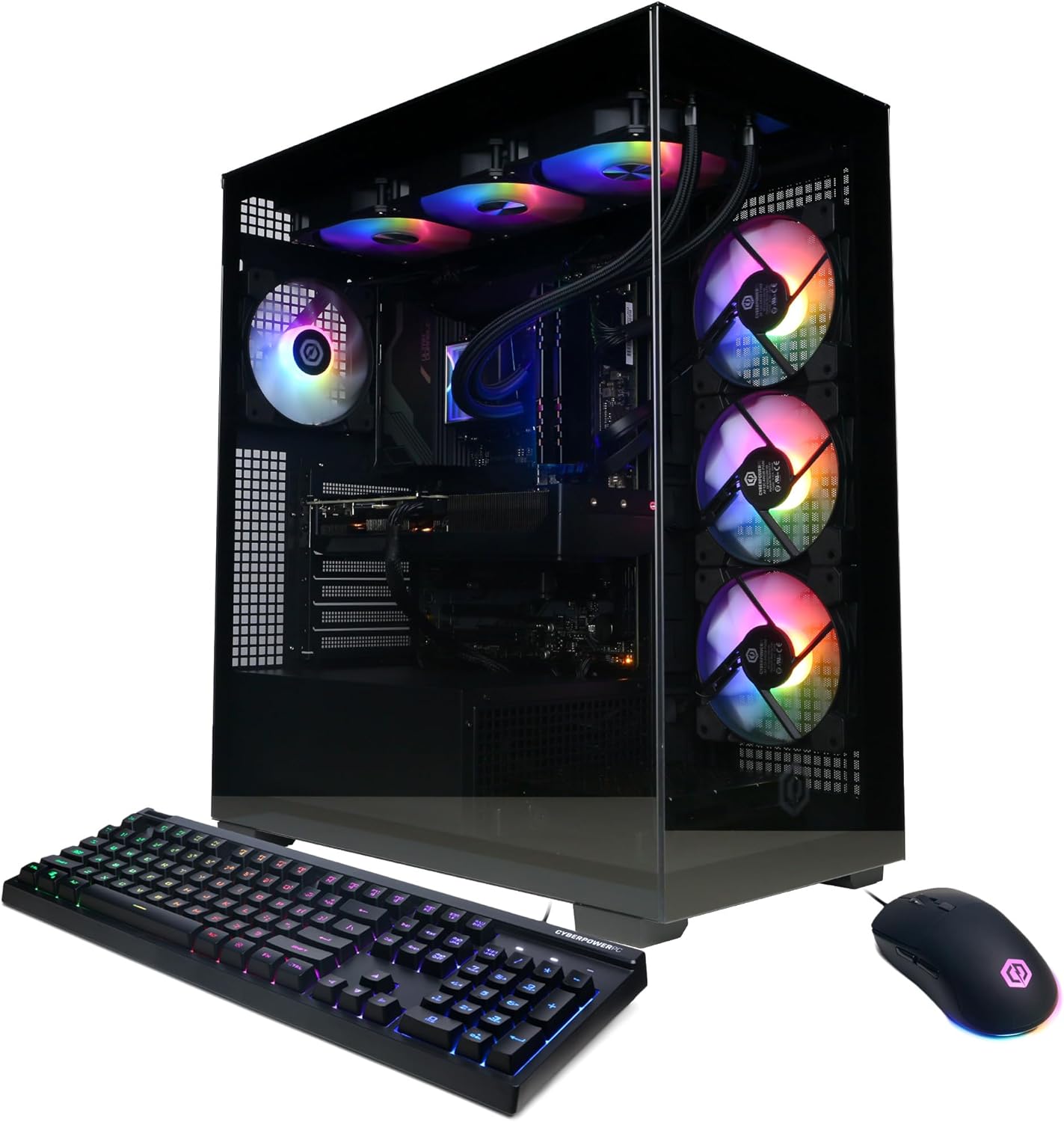
4.4/ 5

4.7/ 5
As an Amazon Associate we earn from qualifying purchases, at no additional cost to you.
Swipe across to compare all columns
| Product | Key highlights | Rating | Explore |
|---|---|---|---|
|
Premium pick
Skytech Ryzen 7 9850X3D
|
Ryzen 7 9850X3D CPU
RTX 5080 16GB
32GB DDR5 6000
2TB NVMe SSD
|
4.7/ 5 | Check Price |

Best for CPU-heavy mods
iBUYPOWER Element
|
Ryzen 9 7900X CPU
RTX 5070 12GB
32GB DDR5 memory
1TB NVMe SSD
|
4.3/ 5 | Check Price |
|
Best value
Skytech Ryzen 7 9800X3D
|
Ryzen 7 9800X3D CPU
RTX 5070 Ti 16GB
32GB DDR5 6000
2TB NVMe SSD
|
4.2/ 5 | Check Price |
|
Best value
CyberPowerPC Ryzen 7 8700F
|
Ryzen 7 8700F CPU
RTX 5060 Ti 8GB
16GB DDR5 memory
1TB NVMe SSD
|
4.3/ 5 | Check Price |

Best value
Gamer Xtreme i7
|
Core i7 quad-core CPU
RTX 3050 8GB
32GB DDR4 memory
1TB SATA SSD
|
5.0/ 5 | Check Price |

Best value
Volt X3 V1.2
|
Ryzen 5 2600 CPU
GTX 1070 8GB
16GB DDR4 memory
512GB NVMe SSD
|
4.7/ 5 | Check Price |

Best value
Gamer Master i7
|
Core i7 quad-core CPU
RTX 3050 6GB
32GB DDR4 memory
1TB SSD
|
4.9/ 5 | Check Price |

Best for light mods
STGAubron R5 5500
|
Ryzen 5 5500 CPU
RTX 3050 6GB
16GB DDR4 memory
1TB SSD
|
4.0/ 5 | Check Price |
|
Best overall
CyberPowerPC i9-14900KF
|
Core i9-14900KF CPU
RTX 5070 12GB
32GB DDR5 memory
2TB NVMe SSD
|
4.4/ 5 | Check Price |

Best memory-rich mid-range
Skytech Ryzen 7 5700
|
Ryzen 7 5700 CPU
RTX 5060 8GB
32GB DDR4 memory
1TB NVMe SSD
|
4.5/ 5 | Check Price |
As an Amazon Associate we earn from qualifying purchases, at no additional cost to you.
This Skytech configuration is the most powerful desktop in this comparison, and it is aimed at modders who want maximum headroom for large, layered mod lists. The RTX 5080 with 16GB of GDDR7 memory sits above every other card here, and the Ryzen 7 9850X3D adds a large cache that helps games sensitive to memory latency.
Heavily modded games often strain the processor as much as the graphics card, because scripts, physics, and object counts scale with the number of active mods. The 9850X3D's large cache can help maintain frame pacing in those CPU-heavy scenarios. The RTX 5080's 16GB of video memory gives texture overhauls and high-resolution asset packs room to load without immediate pressure.
The 32GB of DDR5 6000 memory and 2TB NVMe SSD are well matched to modding. Large mod collections, texture packs, and multiple game installs can consume significant storage, and the 2TB drive reduces the need to shuffle files around. The 360mm AIO liquid cooler supports long sessions where heat builds up.
The main limitations are the older WiFi 5 standard and the listed output configuration of one HDMI and one DisplayPort. If you use a wired connection and a single monitor, neither is a problem. For modders who want the strongest overall platform and room to grow, this is the premium choice.
Many mods add scripts, AI routines, and object tracking that increase the amount of data the processor juggles. A large cache can reduce the time spent waiting on memory, which can translate into smoother frame times in crowded, heavily modded scenes.
Modders who need newer wireless connectivity should compare the KOTIN model. Anyone who wants more native display outputs should check port layouts before buying.
As an Amazon Associate we earn from qualifying purchases, at no additional cost to you.
The iBUYPOWER Element pairs the twelve-core Ryzen 9 7900X with the RTX 5070 12GB, making it the most CPU-heavy option in this comparison below the top Skytech model. For modders who run script-heavy packs, large NPC overhauls, or simulation-style mods, that extra core count provides useful headroom.
Modded games can be surprisingly CPU-bound. Scripts, AI, and object tracking all run on the processor, and a twelve-core chip gives you more room to absorb those loads without frame time spikes. The RTX 5070 12GB provides enough video memory for many texture overhauls, though 12GB is less forgiving than the 16GB cards here for very large packs.
The 32GB of DDR5 memory supports large mod lists and background applications, and the six USB 3.1 ports give you room for peripherals. The 1TB NVMe SSD is the main practical limitation: mod collections and multiple game installs can fill it quickly, so buyers should plan to add a drive.
This desktop makes sense for a modder who values CPU headroom over maximum video memory. If your mod list centers on texture overhauls at high resolution, the 16GB cards are a better fit. For script-heavy packs and multitasking, the Ryzen 9 is a strong choice.
Not every mod list is CPU-bound, but large overhauls with many active scripts can be. The Ryzen 9's twelve cores give you more room to absorb those loads, especially if you also run voice chat, a browser, or mod management tools.
Modders with large texture packs should prioritize 16GB of video memory. Anyone with a big mod library should choose a 2TB model or plan to add storage.
As an Amazon Associate we earn from qualifying purchases, at no additional cost to you.
The Skytech Ryzen 7 9800X3D with the RTX 5070 Ti is the value-focused pick for heavily modded games. It uses the same 360mm liquid cooling and 2TB SSD as the top Skytech model, but steps down to the RTX 5070 Ti 16GB. That card still offers 16GB of video memory, which is the key figure for texture-heavy mod packs.
Texture overhauls and high-poly asset mods consume video memory quickly. The RTX 5070 Ti's 16GB gives those packs room to load without immediately hitting a limit, and it supports modern features that help with performance. The Ryzen 7 9800X3D's large cache can help with CPU-heavy mod lists, making this a well-rounded modding platform.
The 32GB of DDR5 6000 memory and 2TB NVMe SSD are well matched to large mod collections. The 360mm AIO liquid cooler supports long sessions. The main limitations are the older WiFi 5 standard and less GPU headroom than the RTX 5080 model.
Choose this desktop if you want 16GB of video memory and a gaming-focused CPU without paying the flagship price. If you want the maximum graphics headroom, the RTX 5080 model is the step up. For most modders, the RTX 5070 Ti is already a capable card.
High-resolution texture packs can push video memory usage well beyond what the base game requires. A 16GB card gives those packs more room before the GPU has to swap data, which can reduce stutter when new assets load.
Modders who want the highest possible settings should choose an RTX 5080 model. Anyone who needs the newest wireless standard should plan for a wired connection.
As an Amazon Associate we earn from qualifying purchases, at no additional cost to you.
The CyberPowerPC Ryzen 7 8700F pairs an eight-core processor with the RTX 5060 Ti 8GB, 16GB of DDR5 memory, and a 1TB NVMe SSD. It is an affordable entry point for modding games at moderate settings, especially for players who focus on gameplay mods rather than massive texture overhauls.
The Ryzen 7 8700F provides enough processing power for many mod lists, and the RTX 5060 Ti handles moderate graphics loads. The 8GB of video memory is the main limitation: large texture packs and high-resolution asset mods can exceed that buffer, causing stutter or forcing lower settings. The 16GB of system memory is also modest for very heavy mod collections.
Connectivity is a strong point, with WiFi 6, Bluetooth 5.3, and two USB-C 3.2 ports. The 1TB NVMe SSD provides fast load times and reasonable storage, though large mod libraries can fill it. The tempered-glass case and RGB lighting are standard for the category.
This desktop makes sense for a modder who plays with gameplay, UI, and small content mods rather than massive overhauls. If you plan to install large texture packs or hundreds of mods at once, the 32GB and 16GB VRAM configurations are a better fit.
8GB of video memory is enough for many gameplay and content mods at 1080p. Large texture overhauls are where it becomes constrained, so modders should choose settings and pack sizes with that limit in mind.
Modders who plan large texture packs should choose a 16GB card. Anyone who runs hundreds of mods at once should prioritize 32GB of system memory.
As an Amazon Associate we earn from qualifying purchases, at no additional cost to you.
The Gamer Xtreme i7 pairs an Intel Core i7 quad-core processor with the RTX 3050 8GB, 32GB of DDR4 memory, and a 1TB SATA SSD. Its main appeal is the generous memory at a budget price, which can help with mod lists that consume system RAM.
The RTX 3050 is an entry-level graphics card, and it will struggle with large texture overhauls or high-poly mod packs. The quad-core i7 is also older and less capable than the Ryzen 7 and Ryzen 9 processors elsewhere in this list, so script-heavy mod lists will be limited. The 32GB of memory is a genuine advantage for keeping many mod tools and background apps open.
The 1TB SATA SSD provides reasonable storage, though it is slower than NVMe. Connectivity includes WiFi 6, Bluetooth 5.2, and Windows 11 Pro. The listed outputs are one HDMI and one DisplayPort.
This desktop is best for a buyer who wants a general-purpose PC with some modding capability and plenty of memory. If you plan heavy texture mods or demanding games, the RTX 5060 Ti and RTX 5070 models are a better fit.
This configuration puts money into memory rather than graphics. That helps with mod management and multitasking, but it does not solve the GPU bottleneck for large texture packs.
Modders who plan large texture overhauls should choose a stronger graphics card. Buyers who want faster storage should prefer an NVMe drive over the SATA SSD used here.
As an Amazon Associate we earn from qualifying purchases, at no additional cost to you.
The Volt X3 V1.2 is the most affordable desktop in this comparison, and it is aimed at buyers who want to try modding on a budget. The Ryzen 5 2600 and GTX 1070 8GB are older components, but they can still run many games with light mod lists at 1080p.
For heavily modded games, the GTX 1070 and older Ryzen 5 are the limiting factors. Large texture packs, high-poly mods, and script-heavy overhauls will push both the GPU and CPU beyond comfortable limits. The 16GB of DDR4 memory and 512GB NVMe SSD are also modest, and a large mod library will fill that drive quickly.
The case is a white design with a curved glass top, four ARGB fans, and an LCD that displays temperatures. WiFi and Bluetooth are included, along with a top-panel USB-C port. Windows 11 Pro comes installed and activated.
This desktop is a reasonable first step for a modder on a tight budget who plays lighter games. If you plan large overhauls or hundreds of mods, the 32GB and 16GB VRAM configurations are a better fit.
The GTX 1070 can run many games at 1080p with light mod lists. Heavy texture packs and high-poly mods will require reduced settings, and script-heavy lists may stress the older processor.
Modders who plan large texture packs should choose a 16GB card. Anyone with a large mod library should prioritize more storage.
As an Amazon Associate we earn from qualifying purchases, at no additional cost to you.
The Gamer Master i7 pairs an Intel Core i7 quad-core processor with the RTX 3050 6GB, 32GB of DDR4 memory, and a 1TB SSD. It is a budget-focused option with a high customer rating, and the 32GB of memory is useful for mod management and multitasking.
The RTX 3050 6GB is the main limitation for modding. Large texture packs and high-poly mods can exceed its video memory, and the older quad-core processor may struggle with script-heavy mod lists. For lighter mods at 1080p, the combination can still work.
Connectivity includes WiFi 6, Bluetooth 5.2, and a full range of USB ports. The 1TB SSD provides reasonable storage, though a large mod library can fill it. Windows 11 comes pre-installed, and a keyboard and mouse are included.
This desktop makes sense for a budget-conscious modder who plays lighter games and values memory capacity. If you plan heavy texture overhauls or large mod lists, the 16GB VRAM configurations are a better fit.
A high customer rating suggests buyers have been satisfied with this configuration. It is still worth reading individual reviews to understand the experience with the older processor and entry-level graphics card.
Modders who plan large texture packs should choose a 16GB card. Anyone who runs script-heavy mod lists should prioritize a more powerful processor.
As an Amazon Associate we earn from qualifying purchases, at no additional cost to you.
The STGAubron desktop pairs the Ryzen 5 5500 with the RTX 3050 6GB, 16GB of DDR4 memory, and a 1TB SSD. It is a budget option for players who want to try light modding at 1080p without spending much.
The Ryzen 5 5500 has six cores, which is enough for light mod lists but less capable than the Ryzen 7 and Ryzen 9 processors here. The RTX 3050 6GB has limited video memory, so large texture packs will be constrained. The 16GB of system memory is also modest for very heavy mod collections.
The case includes six RGB fans, and connectivity includes WiFi 6 and Bluetooth 5.0. The 1TB SSD provides reasonable storage. The listed customer rating of 4.0 is lower than most alternatives, so reading owner feedback is worthwhile.
This desktop makes sense for a budget-conscious modder who plays lighter games with small mod lists. If you plan large overhauls or hundreds of mods, the 32GB and 16GB VRAM configurations are a better fit.
At this price, the focus is on light modding and moderate settings. Smaller texture packs, fewer active mods, and external storage can help stretch the hardware.
Modders with large texture packs should choose a 16GB card. Anyone who runs many mods at once should prioritize 32GB of memory.
As an Amazon Associate we earn from qualifying purchases, at no additional cost to you.
This CyberPowerPC configuration is the Best overall pick for heavily modded games because it pairs a very fast 24-core processor with a capable graphics card, 32GB of memory, and a 2TB SSD. The Core i9-14900KF is the most CPU-capable processor in this comparison, which matters for script-heavy mod lists, large NPC overhauls, and simulation-style mods.
Modded games can be CPU-bound in ways that vanilla games are not. The i9's 24 cores and high clock speeds give it more room to absorb those loads while the RTX 5070 12GB handles the graphics side. The 12GB of video memory is enough for many texture overhauls, though it is less forgiving than the 16GB cards for very large packs.
The 32GB of DDR5 memory and 2TB NVMe SSD are well matched to large mod collections and multiple game installs. Liquid cooling helps sustain performance during long sessions. Connectivity includes USB-C 3.2 and several USB-A ports for modding peripherals and external drives.
The main limitations are the 12GB of video memory compared with 16GB rivals, and the older WiFi 5 and Bluetooth 4.2 standards. If your mod list centers on CPU-heavy scripts, this is the strongest choice. If large texture packs are your priority, compare the 16GB cards.
Heavily modded games often run many scripts and AI routines at once. The i9's 24 cores give it more room to handle those loads without frame time spikes, especially when combined with mod management tools and background applications.
Modders who prioritize large texture packs should choose a 16GB card. Anyone who wants the newest wireless standard should plan for a wired connection.
As an Amazon Associate we earn from qualifying purchases, at no additional cost to you.
The Skytech Ryzen 7 5700 pairs an older eight-core processor with the RTX 5060 8GB, 32GB of DDR4 memory, and a 1TB NVMe SSD. It is aimed at modders who want plenty of system memory for large mod lists and a capable 1080p experience without a premium price.
The 32GB of memory is the standout feature here. Mod lists that add many objects, scripts, and tools can consume system RAM, and 32GB gives you more room to keep everything loaded. The RTX 5060 8GB handles moderate mods at 1080p, though its video memory limits very large texture packs. The Ryzen 7 5700 is older than the other processors in this list but still has eight cores.
The case features triple tempered-glass panels and a high-performance air cooler. Connectivity includes WiFi and USB ports, and a keyboard and mouse are included. The main limitations are the older processor platform and the 8GB of video memory.
This desktop makes sense for a modder who prioritizes system memory over maximum video memory. If you plan large texture overhauls, the 16GB cards are a better fit. For mod lists that are heavy on content and scripts but moderate on textures, the 32GB of RAM is a real advantage.
32GB of system memory lets you keep large mod lists, mod management tools, and other applications open without pressure. That is useful for modders who iterate on loadouts frequently.
Modders who plan large texture packs should choose a 16GB card. Anyone who wants a newer processor platform should compare the Ryzen 7 8700F or i9 models.
As an Amazon Associate we earn from qualifying purchases, at no additional cost to you.
Modding shifts the hardware balance. The right desktop depends on the kinds of mods you install, how many you run at once, and how much room you want for future additions. These factors explain what to prioritize.
Many mods add scripts, AI routines, and object tracking that run on the processor. A mod list with hundreds of active plugins can push a CPU harder than the base game ever would, especially in crowded scenes. The desktops here range from older quad-core and six-core processors up to the 24-core Core i9-14900KF and the twelve-core Ryzen 9 7900X. For heavy modding, a modern eight-core processor is a sensible baseline, and more cores provide headroom for script-heavy packs.
AMD's X3D processors, such as the Ryzen 7 9800X3D and 9850X3D, include a large cache that can help games sensitive to memory latency. That can be useful when mods increase the amount of data the processor juggles. However, the benefit varies by game and mod type.
If your mod list is script-heavy or you run mod management tools alongside the game, prioritize CPU cores and cache. If your mods are mostly cosmetic, a modern eight-core processor is usually sufficient.
Texture overhauls and high-poly asset mods increase video memory usage well beyond what the base game requires. A card with more VRAM can hold those assets without swapping to slower memory. In this comparison, the RTX 5080 and RTX 5070 Ti offer 16GB, the RTX 5070 offers 12GB, and the RTX 5060 Ti, RTX 5060, RTX 3050, and GTX 1070 offer 8GB or less.
The GPU also determines how well the game runs at your chosen resolution. A stronger card leaves more room for high-resolution textures and effects. Features like DLSS can help recover frame rate when the load is heavy.
If you plan large texture packs, prioritize 16GB of VRAM. For gameplay and content mods, a 12GB or 8GB card can be sufficient at 1080p.
Modded games often use more system memory than vanilla versions, especially when mods add objects, scripts, and background processes. 16GB can work for light mod lists, but 32GB gives more headroom and reduces the chance of slowdowns when you run mod management tools and other applications. Most desktops in this comparison offer 32GB, while the CyberPowerPC Ryzen 7 8700F, Volt X3, and STGAubron models use 16GB.
Memory speed matters less than capacity for modding, though faster DDR5 can help in CPU-limited scenarios. The Skytech models list DDR5 6000, while some configurations use DDR4.
If you run large mod lists or keep many tools open, choose 32GB. If you only use a few mods at a time, 16GB is workable but leaves less room for growth.
Mod collections, texture packs, and multiple game installs can consume significant storage. The desktops here offer 512GB, 1TB, or 2TB SSDs. A 512GB drive fills quickly with mods and games. A 1TB drive is a reasonable middle ground, and a 2TB drive gives more freedom. NVMe drives are faster than SATA, which reduces load times when the game streams in modded assets.
Storage is one of the easier components to add later, but prebuilt systems vary in accessibility. If you choose a smaller drive, check whether there is room for an additional M.2 drive.
Modders with large libraries should prioritize 2TB. If you keep only a few games modded at a time, 1TB is manageable.
Modded games can run the CPU and GPU harder than vanilla versions, and long sessions generate sustained heat. The 360mm AIO liquid coolers on the Skytech models are the most aggressive setups, while the MSI and CyberPowerPC configurations use air or smaller liquid cooling. A good air cooler can handle modded gaming, but a large liquid cooler generally offers more thermal headroom.
Case airflow matters as much as the cooler type. Look for a case with intake and exhaust fans and enough clearance for the graphics card.
If you run long modded sessions, prioritize strong cooling. For shorter sessions, a good air cooler is sufficient.
Modders often use external drives, controllers, and other accessories. Having enough USB ports, and the right types, matters. The CyberPowerPC i9 and Ryzen 7 8700F models list USB-C ports, while some other models do not. Check that the ports you need are present and accessible.
For downloading large mod packs, a wired Ethernet connection is generally more stable. WiFi 6 on several models and WiFi 5 on others provide wireless options.
Match the connectivity to your workflow. If you use external drives or many accessories, prioritize a desktop with plenty of USB-A and USB-C ports.
Set up your desktop with adequate airflow, keeping clearance around the case vents. Connect your monitor to the graphics card output rather than the motherboard output. When installing mods, use a mod manager where possible, and keep backups of working loadouts before adding new mods in bulk.
Keep the cooling system clean by checking the case fans and radiator for dust every few months. Dust reduces airflow and can cause higher temperatures and louder fan noise. Use compressed air to clean the fans and vents while the system is off.
Update your graphics drivers and game patches regularly, as mod compatibility can change with new releases. Monitor temperatures during long modded sessions, and adjust settings if temperatures climb too high. Keep an eye on storage space, since mod libraries can grow quickly.
A modern eight-core processor is a sensible baseline for most mod lists. If you run script-heavy packs or many mods at once, a processor with more cores like the Ryzen 9 7900X or Core i9-14900KF provides more headroom.
Large texture overhauls can push video memory usage well beyond the base game. 16GB provides comfortable headroom, 12GB is workable at 1440p, and 8GB can be constrained with very large packs at high resolution.
16GB can work for light mod lists, but large mod collections and mod management tools often consume more. 32GB provides more headroom and reduces the chance of slowdowns when running many mods at once.
Mod collections, texture packs, and multiple game installs can consume significant space. A 512GB drive fills quickly, a 1TB drive is a reasonable middle ground, and a 2TB drive gives more freedom.
A good air cooler can handle modded gaming, but a 360mm liquid cooler generally provides more thermal headroom during long sessions. If you run heavy mod lists for hours, liquid cooling is a worthwhile consideration.
Yes, especially for texture overhauls and high-poly mods. A stronger GPU with more VRAM can hold larger assets without stutter. However, CPU-heavy mod lists may benefit more from a faster processor.
Many prebuilt desktops allow memory and storage upgrades, but it depends on the motherboard and available slots. Check the memory configuration and drive bays before buying if you plan to upgrade.
Stutter can come from CPU bottlenecks, insufficient VRAM, slow storage, or mod conflicts. Identifying the cause usually means monitoring CPU and GPU usage and testing mods in smaller groups.
A wired Ethernet connection is generally more stable for large downloads. WiFi 6 or WiFi 7 can work well with a strong signal, but wired is the safer choice for long downloads and online play.
The CyberPowerPC i9-14900KF is the strongest overall choice in this comparison for heavily modded games. Its 24-core processor, RTX 5070 12GB, 32GB of memory, 2TB SSD, and liquid cooling make it well suited to script-heavy mod lists and large content packs.
For modders who prioritize video memory, the Skytech Ryzen 7 9850X3D with the RTX 5080 and the Skytech Ryzen 7 9800X3D with the RTX 5070 Ti both offer 16GB and 2TB of storage. The iBUYPOWER Element provides twelve CPU cores for script-heavy packs. Budget-conscious modders should consider the CyberPowerPC Ryzen 7 8700F or the Skytech Ryzen 7 5700, keeping the 8GB VRAM limit in mind.
Your final decision should start with the kinds of mods you install. Prioritize CPU cores for script-heavy lists, 16GB of VRAM for large texture packs, and 32GB of memory for big collections. The right desktop is the one that matches your modding style and budget without paying for capability you will not use.