

Skytech Ryzen 7 9800X3D
4.2/ 5
Ryzen 7 9800X3D processor
RTX 5070 Ti 16GB
32GB DDR5 6000 memory
2TB NVMe SSD storage
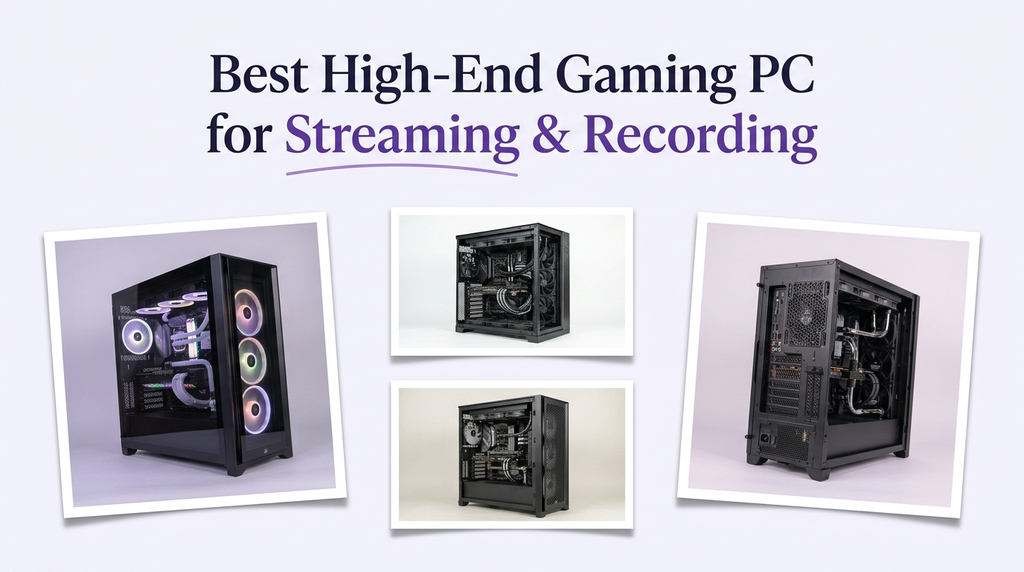
Streaming and recording while gaming turns one demanding workload into several. The game needs a strong GPU, the encoder needs CPU or GPU headroom, and recording software needs fast storage and enough memory. We compare 10 high-end desktops by processor, graphics card, memory, storage, cooling, and connectivity to help you find a machine that handles both the game and the broadcast.
The right desktop for this job is not simply the fastest gaming PC. A processor with enough cores keeps the game, encoder, voice chat, and browser running smoothly, while a modern graphics card can offload encoding through its built-in hardware encoder. Memory capacity and SSD speed affect multitasking and recording stability, and cooling matters during long sessions.
To build this guide, we compared the listed specifications and customer ratings across all ten desktops. We weighed processor core counts and generations, graphics card tier and video memory, memory capacity and speed, SSD size, cooling design, USB and wireless connectivity, and case expansion room. We also considered how each machine fits different streaming and recording workflows rather than ranking by price alone. The recommendations reflect specification-based reasoning, not measured test results.
4.2/ 5

4.7/ 5
As an Amazon Associate we earn from qualifying purchases, at no additional cost to you.
Swipe across to compare all columns
| Product | Key highlights | Rating | Explore |
|---|---|---|---|
|
Premium pick
Skytech Ryzen 7 9850X3D
|
Ryzen 7 9850X3D CPU
RTX 5080 16GB
32GB DDR5 6000
2TB NVMe SSD
|
4.7/ 5 | Check Price |
|
Best overall
KOTIN Ryzen 7 9850X3D
|
Ryzen 7 9850X3D CPU
RTX 5080 16GB
32GB DDR5 memory
2TB PCIe 4.0 SSD
|
Not supplied | Check Price |

Best for CPU-heavy workflows
iBUYPOWER Element
|
Ryzen 9 7900X CPU
RTX 5070 12GB
32GB DDR5 memory
1TB NVMe SSD
|
4.3/ 5 | Check Price |

Best value
RTX 3060 Ti Prebuilt
|
Ryzen 5 5500 CPU
RTX 3060 Ti 8GB
16GB DDR4 memory
512GB SSD
|
4.5/ 5 | Check Price |

Best for massive memory
HP OMEN 45L
|
Core i7-12700KF CPU
GTX 1660 Super
64GB DDR4 memory
2TB NVMe SSD
|
4.5/ 5 | Check Price |

Best mid-range balance
MSI Codex Z2 RTX 5070
|
Ryzen 7 8700F CPU
RTX 5070 12GB
32GB DDR5 memory
2TB NVMe SSD
|
4.2/ 5 | Check Price |

Best value
Gamer Xtreme i7
|
Core i7 quad-core CPU
RTX 3050 8GB
32GB DDR4 memory
1TB SATA SSD
|
5.0/ 5 | Check Price |

Best low-cost entry
STGAubron Gaming PC
|
Core i7 8th-gen CPU
RTX 3050 6GB
16GB DDR4 memory
512GB SSD
|
3.8/ 5 | Check Price |

Best white build
Skytech Ryzen 7 9850X3D White
|
Ryzen 7 9850X3D CPU
RTX 5070 Ti 16GB
32GB DDR5 6000
1TB NVMe SSD
|
Not supplied | Check Price |
|
Best value
Skytech Ryzen 7 9800X3D
|
Ryzen 7 9800X3D CPU
RTX 5070 Ti 16GB
32GB DDR5 6000
2TB NVMe SSD
|
4.2/ 5 | Check Price |
As an Amazon Associate we earn from qualifying purchases, at no additional cost to you.
This Skytech configuration is the most powerful desktop in this comparison, and it suits streamers who want maximum game performance while leaving room for encoding and recording. The RTX 5080 with 16GB of GDDR7 memory is the top graphics card here, and the Ryzen 7 9850X3D adds a large cache that helps games sensitive to memory latency.
For streaming and recording, the graphics card matters in two ways. It renders the game, and it can handle hardware encoding through its built-in encoder, which offloads work from the processor. That division of labor keeps frame rates steadier when you stream at high quality. The 32GB of DDR5 6000 memory gives you room for the game, capture software, voice chat, and a browser, while the 2TB NVMe SSD provides space for recorded footage and game installs.
Cooling is handled by a 360mm AIO liquid cooler with ARGB fans, a setup suited to long stream sessions where heat builds up. The case is a showcase design with a tempered-glass panel, so check the dimensions against your desk. USB 2.0, 3.0, and 3.2 Gen1 ports are available for capture cards, microphones, and other peripherals.
The main limitation is connectivity: the listed graphics outputs are one HDMI and one DisplayPort, and the wireless standard is WiFi 5. If you use a wired network for streaming, WiFi 5 may not matter. If you want the strongest game performance in this group and plan to encode on the GPU, this is a top-tier choice.
A capture card usually connects over USB or PCIe, while your monitor uses HDMI or DisplayPort. Confirm that the ports you need are available and that the graphics card outputs match your monitor inputs. If you need more outputs than the card provides, plan for adapters or a different connection layout.
Streamers who need newer wireless connectivity should compare the KOTIN model. Anyone who wants more native display outputs should check port layouts before buying.
As an Amazon Associate we earn from qualifying purchases, at no additional cost to you.
The KOTIN desktop earns the Best overall badge because it combines the top-tier RTX 5080 and Ryzen 7 9850X3D with newer connectivity and more expansion room. For streamers, that means strong game performance plus the headroom to encode, record, and run chat and browser windows without obvious strain.
The RTX 5080 16GB supports DLSS 4, ray tracing, and Reflex, and its hardware encoder can handle video encoding while the game runs. The Ryzen 7 9850X3D brings a large cache that helps games sensitive to memory latency, and the 32GB of DDR5 memory supports multitasking across streaming software and the game. The 2TB PCIe 4.0 SSD gives you room for recordings, VODs, and a large game library.
Connectivity is where this model pulls ahead. WiFi 7 and Bluetooth are current standards, and the 850W 80+ Gold power supply provides headroom for future upgrades. The 360mm AIO cooler with nine ARGB fans suggests strong airflow, and three M.2 slots make it easier to add storage later. The 3.95-inch IPS display can show CPU temperatures and custom images.
The main caution is the lack of a customer rating, which means less owner feedback to draw on. The curved glass design also needs careful placement. If you want the strongest overall specification for streaming and recording and are comfortable buying without a rating history, this is the pick.
Three M.2 slots and support for up to 256GB of DDR5 give this desktop more long-term upgrade potential than most rivals. That matters if your recordings, VODs, and game library grow over time.
Buyers who prefer to rely on a listed customer rating may favor the Skytech model. Anyone who wants a simpler case design without curved glass should check the alternatives.
As an Amazon Associate we earn from qualifying purchases, at no additional cost to you.
The iBUYPOWER Element is built around the twelve-core Ryzen 9 7900X, making it the most CPU-heavy option in this comparison below the top Skytech and KOTIN models. For streamers who prefer CPU encoding, or who run heavy software alongside the game, that extra core count provides useful headroom.
The RTX 5070 12GB is a capable gaming card, and it also includes a hardware encoder for GPU-based streaming. The 32GB of DDR5 memory supports multitasking across the game, encoder, chat, and browser. The six USB 3.1 ports give you room for a capture card, microphone, and other peripherals.
The main limitation is storage. A 1TB NVMe SSD can fill quickly with recorded footage, VODs, and modern game installs, so buyers who record a lot should plan to add a drive. The tempered-glass RGB case is a standard design, and there is no USB-C port listed, which may matter for newer accessories.
This desktop makes sense for a streamer who wants strong CPU headroom for encoding and multitasking. If your priority is maximum gaming performance or more storage out of the box, the RTX 5080 models and 2TB configurations are better choices.
CPU encoding can offer high quality at a given bitrate, but it uses processor cores that the game also needs. GPU encoding offloads that work to the graphics card. A twelve-core processor gives you more flexibility to choose either approach.
Streamers who record long sessions should choose a desktop with more storage. Anyone who wants the strongest gaming performance should compare the RTX 5080 models.
As an Amazon Associate we earn from qualifying purchases, at no additional cost to you.
This prebuilt pairs the RTX 3060 Ti with the Ryzen 5 5500, 16GB of RAM, and a 512GB SSD. It is the most affordable way into RTX-class gaming in this comparison, and it is a reasonable starting point for a new streamer who wants to test the waters without a large investment.
The RTX 3060 Ti includes a hardware encoder that can handle streaming and recording with less strain on the processor than CPU encoding. That makes it more capable for streaming than its price might suggest. The Ryzen 5 5500 has six cores, which is enough for gaming and a single encoding workload, though heavy multitasking will push it.
The 16GB of RAM is the main constraint for streamers who run many applications at once, and the 512GB SSD fills quickly with recordings and game installs. The case has six RGB fans and dust filters, which is a sensible airflow design for the price. Windows 11 comes pre-installed.
This desktop makes sense for a new streamer on a tight budget who is willing to manage storage and keep background apps light. If you record long sessions or run heavy multitasking, a 32GB configuration with more storage is a better fit.
Use the GPU encoder rather than CPU encoding to reduce strain on the processor. Record to an external drive if the internal SSD fills up, and close unnecessary background applications before going live.
Streamers who run many applications at once should choose 32GB of memory. Anyone who records long sessions should prioritize a larger SSD or plan for external storage.
As an Amazon Associate we earn from qualifying purchases, at no additional cost to you.
The HP OMEN 45L is an unusual configuration. It pairs a twelve-core Intel Core i7-12700KF with 64GB of RAM and a 2TB PCIe Gen4 SSD, but it uses the older GTX 1660 Super graphics card. For streaming and recording, that mix favors multitasking and storage over raw gaming performance.
The 64GB of memory is the standout feature. It lets you run the game, encoder, chat, browser, and recording software without worrying about memory pressure. The i7-12700KF has plenty of cores for CPU encoding, and the 2TB SSD provides ample space for recordings. Liquid cooling helps manage heat during long sessions.
The limitation is the graphics card. The GTX 1660 Super is an older card that will struggle with modern games at high settings, and it lacks the newer hardware encoders found on RTX cards. For streaming, you may need to rely more on CPU encoding or accept lower game settings.
This desktop makes sense for a creator who prioritizes memory and storage for recording and multitasking, and who plays less demanding games. If you want strong modern gaming performance, the RTX 5070 and RTX 5080 models are a better fit.
Large memory capacity helps when you run many applications at once, edit high-resolution video, or keep large projects open. For streaming alone, 32GB is usually enough, but 64GB provides extra headroom for heavy workflows.
Gamers who want high frame rates in modern titles should choose a desktop with a newer graphics card. Streamers who rely on GPU encoding will also benefit from an RTX card.
As an Amazon Associate we earn from qualifying purchases, at no additional cost to you.
The MSI Codex Z2 with the Ryzen 7 8700F and RTX 5070 is a balanced mid-range desktop that fits streaming and recording at moderate settings. The eight-core Ryzen processor has enough headroom for the game, encoder, and chat, while the RTX 5070 12GB provides modern gaming performance and a hardware encoder.
The RTX 5070 is a capable card for 1440p gaming, and its encoder can handle streaming and recording with less strain on the processor. The 32GB of DDR5 memory supports multitasking, and the 2TB SSD provides generous space for recorded footage and game installs.
Cooling uses an ARGB air cooler plus four case fans, which is adequate for a Ryzen 7 but less aggressive than the 360mm liquid coolers on the Skytech and KOTIN models. There is no USB-C port listed, so check your accessories. The built-in RGB lighting can be controlled through MSI Center.
This is a good choice for a streamer who wants a well-rounded desktop without paying the top-tier price. If you want maximum gaming performance or liquid cooling, the RTX 5070 Ti and RTX 5080 models are the step up.
An air cooler with four case fans can handle a Ryzen 7 during streaming, though it may run louder under sustained load than a large liquid cooler. Ensure the case has clearance and good airflow.
Streamers who want the quietest cooling under long sessions may prefer a liquid-cooled model. Anyone who needs USB-C for a capture card or accessory should verify the port layout.
As an Amazon Associate we earn from qualifying purchases, at no additional cost to you.
The Gamer Xtreme i7 pairs an Intel Core i7 quad-core processor with the RTX 3050 8GB, 32GB of DDR4 memory, and a 1TB SATA SSD. Its main appeal is the generous memory at a budget price, along with WiFi 6, Bluetooth 5.2, and Windows 11 Pro.
For streaming, the RTX 3050 includes a hardware encoder, but its gaming performance is modest. The quad-core i7 is older and less capable than the Ryzen 7 and Ryzen 9 processors elsewhere in this list, so heavy multitasking will be limited. The 32GB of memory is a genuine advantage for running chat, browser, and recording software alongside the game.
The 1TB SATA SSD provides reasonable storage, though it is slower than NVMe. The listed outputs are one HDMI and one DisplayPort. The case has a tempered-glass panel and an efficient cooling design.
This desktop is best for a buyer who wants a general-purpose PC with some streaming capability and plenty of memory. If you want strong gaming performance or faster storage, the RTX 5070 and above models are a better fit.
This configuration puts money into memory and storage rather than graphics. That helps everyday multitasking, but it does not solve the gaming performance gap for demanding titles.
Streamers who play demanding games should choose a stronger graphics card. Buyers who want faster storage should also prefer an NVMe drive over the SATA SSD used here.
As an Amazon Associate we earn from qualifying purchases, at no additional cost to you.
The STGAubron Gaming PC is the most affordable desktop in this comparison, and it is aimed at casual gamers and new streamers on a very tight budget. It uses an 8th-generation Intel Core i7, the RTX 3050 6GB, 16GB of DDR4 memory, and a 512GB SSD.
For streaming, the RTX 3050 includes a hardware encoder, which helps with light streaming and recording. However, the older CPU and entry-level GPU limit gaming performance, and the 16GB of memory and 512GB SSD are modest for running a game, encoder, and chat at once.
The case includes four RGB fans and comes with a gaming keyboard and mouse. WiFi 6 and Bluetooth 5.2 are included, and Windows 11 Home is pre-installed. The listed customer rating of 3.8 is lower than most alternatives, so reading owner feedback is worthwhile.
This desktop makes sense for a casual streamer who wants to start with minimal investment and is willing to keep expectations modest. If you want smoother performance or more storage, the RTX 3060 Ti prebuilt or a 32GB configuration is a better starting point.
At this price, the focus is on light gaming and simple streaming. Lower game settings, shorter recording sessions, and external storage can help stretch the hardware.
Streamers who want smoother gameplay should choose a stronger graphics card. Anyone who runs many applications at once should prioritize 32GB of memory.
As an Amazon Associate we earn from qualifying purchases, at no additional cost to you.
This Skytech model pairs the Ryzen 7 9850X3D with the RTX 5070 Ti 16GB in a white King 95 3D case. It is aimed at streamers who want a distinctive build and modern connectivity without stepping up to the RTX 5080 tier.
The RTX 5070 Ti 16GB is a capable gaming card with a hardware encoder for streaming and recording. The Ryzen 7 9850X3D provides strong game performance, and the 32GB of DDR5 6000 memory supports multitasking. WiFi 6 and Bluetooth are included, which is more current than the WiFi 5 on some alternatives.
The main limitation is storage. A 1TB NVMe SSD can fill quickly with recorded footage and game installs, so streamers who record a lot should plan to add a drive. There is no customer rating listed, so owner feedback is limited.
Choose this desktop if you want a white-themed build with WiFi 6 and strong gaming performance. If you record heavily or want more storage out of the box, the 2TB Skytech model is a better fit.
A white case and components can suit a light-themed streaming setup. The King 95 3D case is a showcase design, so check that its dimensions and styling fit your space.
Streamers who record long sessions should choose a 2TB model. Anyone who wants a listed customer rating may prefer the black Skytech configuration.
As an Amazon Associate we earn from qualifying purchases, at no additional cost to you.
The Skytech Ryzen 7 9800X3D with the RTX 5070 Ti is the value-focused pick for streaming and recording. It pairs the gaming-focused 9800X3D with the RTX 5070 Ti 16GB, 32GB of DDR5 6000 memory, and a 2TB NVMe SSD.
The RTX 5070 Ti includes a hardware encoder that can handle streaming and recording while the game runs. The 9800X3D's large cache helps games sensitive to memory latency, and the 32GB of memory supports multitasking across streaming software. The 2TB SSD is a meaningful advantage for streamers who record frequently.
Cooling is handled by a 360mm AIO liquid cooler, which is suited to long sessions. The main limitations are the older WiFi 5 standard and less GPU headroom than the RTX 5080 models. For most streamers, the RTX 5070 Ti is already capable.
Choose this desktop if you want strong streaming performance with ample storage at a more accessible price. If you want maximum gaming performance or newer wireless connectivity, the RTX 5080 models are the step up.
Recorded footage and VODs can consume significant space. A 2TB drive reduces the need to move files to external storage frequently, which is a practical advantage for regular streamers.
Streamers who want the highest gaming performance should choose an RTX 5080 model. Anyone who needs the newest wireless standard should plan for a wired connection or check for an adapter.
As an Amazon Associate we earn from qualifying purchases, at no additional cost to you.
Streaming and recording add extra workloads to gaming, so the right desktop needs more than a strong graphics card. These factors explain what to prioritize.
When you stream or record, the processor may handle encoding, run the game's logic, and manage voice chat and browser windows. A CPU with more cores gives you more flexibility, especially if you choose CPU encoding for quality reasons. The desktops here range from quad-core and six-core processors up to the twelve-core Ryzen 9 7900X and the twenty-thread Core i7-12700KF. For most streamers, a modern eight-core processor is a comfortable baseline.
CPU encoding can produce high quality at a given bitrate, but it competes with the game for processor resources. GPU encoding offloads that work to the graphics card. Having more CPU cores gives you the option to choose either approach without obvious strain.
If you plan to use CPU encoding or run heavy software alongside the game, prioritize a processor with more cores. If you plan to encode on the GPU, a modern eight-core processor is usually sufficient.
The graphics card serves two roles for streamers. It renders the game, and it provides a hardware encoder that can handle streaming and recording with less strain on the processor. Newer RTX cards include updated encoders that support modern codecs and features. In this comparison, the RTX 5080 16GB sits at the top, followed by the RTX 5070 Ti 16GB and RTX 5070 12GB, with the older GTX 1660 Super and RTX 3050 cards at the lower end.
For streaming, a strong GPU matters most if you play demanding games at high settings. If you play lighter titles, a mid-tier card can be sufficient. The encoder quality and supported codecs also matter, though the difference between recent generations is smaller than the difference in raw gaming performance.
Match the GPU to the games you stream. If you play demanding titles, prioritize an RTX 5070 Ti or RTX 5080. For lighter games, an RTX 5070 or RTX 3060 Ti can be sufficient.
Streaming setups often run the game, encoding software, chat, a browser, and sometimes music or alert tools at the same time. 16GB of RAM can work for a simple setup, but 32GB gives more headroom and reduces the chance of slowdowns. Some desktops here offer 64GB, which is useful for heavy multitasking or video editing but is more than most streamers need.
Memory speed matters less than capacity for streaming, though faster DDR5 can help in CPU-limited scenarios. The Skytech models list DDR5 6000, while other configurations list DDR5 4800 or DDR4.
If you run many applications at once, choose 32GB. If you also edit high-resolution video or keep large projects open, 64GB can be worthwhile. For a simple streaming setup, 16GB is workable but leaves less room for growth.
Recorded footage and VODs can consume large amounts of storage, especially at high bitrates or long session lengths. The desktops here offer 512GB, 1TB, or 2TB SSDs. A 512GB drive fills quickly with recordings and game installs. A 1TB drive is a reasonable middle ground, and a 2TB drive gives more freedom. NVMe drives are faster than SATA, which can reduce load times and improve recording stability.
Storage is one of the easier components to add later, but prebuilt systems vary in accessibility. If you choose a smaller drive, check whether there is room for an additional M.2 or 2.5-inch drive, or plan for external storage.
Streamers who record frequently should prioritize 2TB. If you stream occasionally, 1TB is manageable, especially with external storage for archives.
Long streams can last hours, and both the CPU and GPU generate heat during that time. The cooling system determines whether components can sustain performance without throttling. The 360mm AIO liquid coolers on the Skytech and KOTIN models are the most aggressive setups, while the MSI Codex uses air cooling with four case fans. A good air cooler can handle a Ryzen 7 during streaming, but a large liquid cooler generally offers more thermal headroom and can run quieter.
Case airflow matters as much as the cooler type. Look for a case with intake and exhaust fans and enough clearance for the graphics card. Tempered-glass panels look good but can restrict airflow if the case design lacks vents.
If you stream for hours or live in a warm room, prioritize a model with a 360mm liquid cooler and strong case airflow. For shorter sessions, a good air cooler is sufficient.
A streaming setup often includes a capture card, microphone, webcam, and lighting controls. Having enough USB ports, and the right types, matters. The desktops here list varying combinations of USB-C, USB-A, and rear I/O. The HP OMEN 45L lists ten USB ports including USB-C, while some other models do not list USB-C at all. Check that the ports you need are present and accessible.
Wired Ethernet is generally preferred for stable streaming. WiFi 7 on the KOTIN model and WiFi 6 on several others provide good wireless options, while WiFi 5 is older. Bluetooth is useful for wireless headsets and accessories.
Match the connectivity to your setup. If you use many USB peripherals, prioritize a desktop with plenty of USB-A and USB-C ports. For streaming, a wired Ethernet connection is the most reliable choice.
Set up your desktop with adequate airflow, keeping clearance around the case vents. Connect your monitor to the graphics card output rather than the motherboard output, and connect your capture card and other peripherals to available USB ports. For streaming, use a wired Ethernet connection if possible for stability.
Keep the cooling system clean by checking the case fans and radiator for dust every few months. Dust reduces airflow and can cause higher temperatures and louder fan noise. Use compressed air to clean the fans and vents while the system is off. For liquid coolers, listen for unusual pump noise and monitor temperatures during long sessions.
Update your graphics drivers and streaming software regularly, as encoder support and performance can improve with new releases. Close unnecessary background applications before going live to free up memory and CPU resources. Record to a drive with enough free space, and archive older footage to external storage to keep the internal SSD from filling up.
A modern eight-core processor is a comfortable baseline for most streamers, especially if you encode on the GPU. If you prefer CPU encoding or run heavy software alongside the game, a twelve-core processor like the Ryzen 9 7900X provides more headroom.
GPU encoding offloads work to the graphics card and is generally the easier choice for gaming PCs. CPU encoding can offer high quality at a given bitrate but competes with the game for processor resources. Having more CPU cores gives you the flexibility to choose either approach.
16GB can work for a simple setup with the game and one encoding application. However, streaming often involves chat, a browser, and other tools, so 32GB provides more headroom and reduces the chance of slowdowns.
Recorded footage and VODs can consume large amounts of space. A 512GB drive fills quickly, a 1TB drive is a reasonable middle ground, and a 2TB drive gives more freedom. Consider external storage for archiving older recordings.
If you stream PC games from the same PC, software encoding may be enough. A capture card is useful for streaming console gameplay or for offloading encoding work. Check that your desktop has the required USB or PCIe connections.
A better graphics card improves gaming performance and may provide a newer hardware encoder with support for modern codecs. However, stream quality also depends on bitrate, resolution, and platform settings. For many streamers, a mid-tier RTX card is sufficient.
A typical setup uses a microphone, webcam, capture card, and possibly lighting controls. That can require four to six USB ports. Check the desktop's port count and types, and consider a powered USB hub if you need more.
A wired Ethernet connection is generally more stable for live streaming. WiFi 6 or WiFi 7 can work well if the signal is strong, but wired is preferred for consistent upload performance.
A desktop with adequate cooling can stream for hours without overheating. Liquid cooling and strong case airflow help sustain performance during long sessions. Monitor temperatures and keep vents clear of dust and obstructions.
Many prebuilt desktops allow memory, storage, and sometimes graphics card upgrades, but it depends on the case size, power supply, and motherboard. Check the power supply wattage and available drive bays before buying if you plan to upgrade.
The KOTIN Ryzen 7 9850X3D with the RTX 5080 is the strongest overall choice in this comparison for streaming and recording. Its 16GB graphics card, X3D processor, 32GB of memory, 2TB SSD, WiFi 7, and 850W power supply make it well suited to demanding games and long broadcast sessions.
For buyers who want a similar experience with a listed customer rating, the Skytech Ryzen 7 9850X3D offers the same GPU and CPU combination. The Skytech Ryzen 7 9800X3D with the RTX 5070 Ti is the value pick with a 2TB SSD, while the iBUYPOWER Element provides more CPU cores for CPU encoding. The HP OMEN 45L stands out for its 64GB of memory, though its older graphics card limits gaming performance.
Your final decision should start with how you stream and record. Prioritize the graphics card for gaming performance and hardware encoding, choose 32GB of memory for multitasking, and select enough storage for your recordings. The right desktop is the one that matches your games, your workflow, and your budget without paying for capability you will not use.