

Skytech Ryzen 7 9800X3D
4.2/ 5
Ryzen 7 9800X3D processor
RTX 5070 Ti 16GB
32GB DDR5 6000 memory
2TB NVMe SSD storage
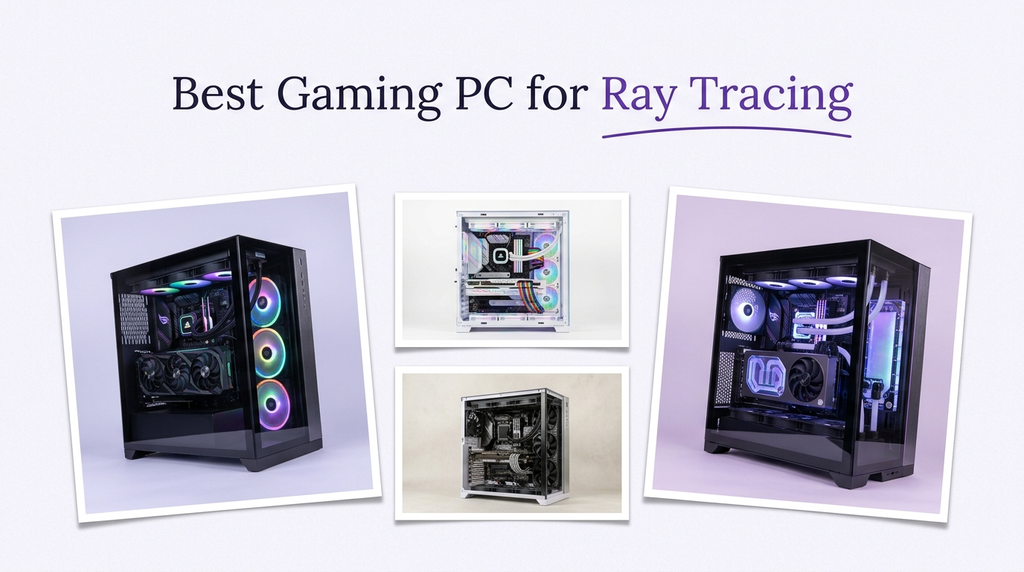
Ray tracing transforms lighting, reflections, and shadows, but it is also one of the most demanding workloads you can ask a gaming PC to handle. A machine built for heavy ray tracing needs a strong graphics card with plenty of video memory, a processor that keeps the frame rate steady, and cooling that can sustain performance during long sessions. We compare 10 desktops by these factors and more.
The difference between a smooth ray-traced experience and a stuttering one usually comes down to the GPU. Ray-traced effects add a second layer of computation on top of standard rendering, so cards with more rendering cores and more VRAM handle the load better. Features like DLSS and frame generation can help, but they work best when the underlying card has enough headroom.
To build this guide, we compared the listed specifications and customer ratings across all ten desktops. We weighed graphics card tier and video memory, processor generation and core count, memory capacity and speed, SSD size, cooling design, power supply, and connectivity. We also considered how each machine fits different ray-tracing workloads rather than ranking by price alone. The recommendations reflect specification-based reasoning, not measured test results.
4.2/ 5

4.7/ 5
As an Amazon Associate we earn from qualifying purchases, at no additional cost to you.
Swipe across to compare all columns
| Product | Key highlights | Rating | Explore |
|---|---|---|---|
|
Best overall
KOTIN Ryzen 7 9850X3D
|
Ryzen 7 9850X3D CPU
RTX 5080 16GB
32GB DDR5 memory
2TB PCIe 4.0 SSD
|
Not supplied | Check Price |
|
Premium pick
Skytech Ryzen 7 9850X3D
|
Ryzen 7 9850X3D CPU
RTX 5080 16GB
32GB DDR5 6000
2TB NVMe SSD
|
4.7/ 5 | Check Price |
|
Best value
Skytech Ryzen 7 9800X3D
|
Ryzen 7 9800X3D CPU
RTX 5070 Ti 16GB
32GB DDR5 6000
2TB NVMe SSD
|
4.2/ 5 | Check Price |

Best for CPU-heavy workloads
iBUYPOWER Element
|
Ryzen 9 7900X CPU
RTX 5070 12GB
32GB DDR5 memory
1TB NVMe SSD
|
4.3/ 5 | Check Price |

Best for local AI
NIMO RTX 5060 Desktop
|
Core i5-14400F CPU
RTX 5060 8GB
32GB DDR5 memory
1TB NVMe SSD
|
4.9/ 5 | Check Price |

Best mid-range balance
MSI Codex Z2 RTX 5070
|
Ryzen 7 8700F CPU
RTX 5070 12GB
32GB DDR5 memory
2TB NVMe SSD
|
4.2/ 5 | Check Price |

Best for WiFi 6
Skytech Ryzen 7 9800X3D 1TB
|
Ryzen 7 9800X3D CPU
RTX 5070 Ti 16GB
32GB DDR5 6000
1TB NVMe SSD
|
Not supplied | Check Price |

Best value
CyberPowerPC Ryzen 7 8700F
|
Ryzen 7 8700F CPU
RTX 5060 Ti 8GB
16GB DDR5 memory
1TB NVMe SSD
|
4.3/ 5 | Check Price |

Best for smart display
KOTIN RTX 5070 Prebuilt
|
Ryzen 7 9700X CPU
RTX 5070 12GB
32GB DDR5 memory
1TB NVMe SSD
|
4.2/ 5 | Check Price |

Best compact ray tracing
MSI Codex Z2 RTX 5060 Ti
|
Ryzen 7 8700F CPU
RTX 5060 Ti 8GB
16GB DDR5 memory
1TB NVMe SSD
|
4.3/ 5 | Check Price |
As an Amazon Associate we earn from qualifying purchases, at no additional cost to you.
The KOTIN desktop earns the Best overall badge because it pairs the top-tier RTX 5080 16GB with the Ryzen 7 9850X3D and adds newer connectivity and more expansion room. For heavy ray tracing, the RTX 5080 is the most capable card in this comparison, with 16GB of GDDR7 memory and support for DLSS 4 and Reflex.
Ray tracing adds a second layer of computation to every frame, so the graphics card matters more than any other component. The RTX 5080's rendering headroom lets you enable ray-traced lighting, reflections, and shadows at higher settings, while DLSS 4 can help recover frame rate when the load is heavy. The Ryzen 7 9850X3D includes 3D V-Cache and 96MB of L3 cache, which can help games that are sensitive to memory latency.
The 32GB of DDR5 memory and 2TB PCIe 4.0 SSD give this machine a strong foundation for large ray-traced titles. The 360mm AIO cooler with nine ARGB fans and the 850W 80+ Gold power supply suggest a build designed for sustained load. WiFi 7, Bluetooth, three M.2 slots, and a 3.95-inch IPS display round out the feature set.
The main caution is the lack of a customer rating, which means less owner feedback to draw on. The curved glass design also needs careful placement. If you want the strongest overall specification for heavy ray tracing and are comfortable buying without a rating history, this is the pick.
Ray-traced effects use additional memory for acceleration structures and higher-resolution textures. A 16GB card like the RTX 5080 leaves more headroom than an 8GB card, reducing the chance of stutter when ray tracing is enabled at high settings.
Buyers who prefer to rely on a listed customer rating may favor the Skytech model. Anyone who wants a simpler case design without curved glass should check the alternatives.
As an Amazon Associate we earn from qualifying purchases, at no additional cost to you.
This Skytech configuration pairs the RTX 5080 16GB with the Ryzen 7 9850X3D, 32GB of DDR5 6000 memory, and a 2TB NVMe SSD. It is the same GPU and CPU combination as the Best overall pick, but it carries a listed customer rating of 4.7, which gives buyers more owner feedback to consider.
For heavy ray tracing, the RTX 5080 is the strongest card in this comparison. Its 16GB of GDDR7 memory and support for DLSS 4 and Reflex make it well suited to ray-traced lighting and reflections at high settings. The Ryzen 7 9850X3D adds a large cache that can help frame pacing in demanding titles.
Cooling is handled by a 360mm AIO liquid cooler with ARGB fans, a setup suited to long sessions where heat builds up. The 32GB of DDR5 6000 memory and 2TB NVMe SSD provide a strong foundation for multitasking and a large game library. The main limitations are the older WiFi 5 standard and the listed output configuration of one HDMI and one DisplayPort.
Choose this desktop if you want flagship ray-tracing performance and prefer a model with a listed customer rating. If you need newer wireless connectivity or more expansion room, the KOTIN model is worth comparing.
DLSS uses AI upscaling to render at a lower internal resolution and reconstruct a higher-resolution image. When ray tracing is enabled, DLSS can help recover frame rate while preserving visual quality. The RTX 5080 supports DLSS 4, which includes newer frame-generation features.
Buyers who need WiFi 7 should compare the KOTIN model. Anyone who wants more native display outputs should check port layouts before buying.
As an Amazon Associate we earn from qualifying purchases, at no additional cost to you.
The Skytech Ryzen 7 9800X3D with the RTX 5070 Ti is the value-focused pick for heavy ray tracing. It uses the same 360mm liquid cooling and 2TB SSD as the top Skytech model, but steps down to the RTX 5070 Ti 16GB. That card still offers 16GB of graphics memory, which is important for ray-traced effects that use additional VRAM.
The RTX 5070 Ti supports ray tracing and DLSS, and its 16GB of memory gives it more headroom than the 8GB and 12GB cards in this comparison. The Ryzen 7 9800X3D is a gaming-focused processor with a large cache, which can help frame pacing in demanding titles. The 32GB of DDR5 6000 memory and 2TB SSD keep the rest of the system well balanced.
Cooling and case design mirror the more expensive Skytech model, so long sessions should be manageable. The same display-output caution applies: one HDMI and one DisplayPort are listed. The older WiFi 5 standard is the other compromise.
Choose this desktop if you want strong ray-tracing performance without paying for the RTX 5080 tier. If you want the maximum graphics headroom, the RTX 5080 models are the step up. For many ray-traced games at 1440p, the RTX 5070 Ti is already a capable card, making this the better value.
16GB of graphics memory provides comfortable headroom for ray tracing at 1440p and many 4K scenarios. It is a meaningful step up from 8GB cards, which can become constrained when ray-traced effects and high-resolution textures are combined.
Players who want the highest ray-traced settings at 4K should choose an RTX 5080 model. Anyone who needs the newest wireless standard should plan for a wired connection.
As an Amazon Associate we earn from qualifying purchases, at no additional cost to you.
The iBUYPOWER Element pairs the twelve-core Ryzen 9 7900X with the RTX 5070 12GB, making it a strong choice for buyers who want ray tracing alongside heavy multitasking. The extra CPU cores help if you stream, record, or run creative software while gaming.
The RTX 5070 12GB supports ray tracing and DLSS, and it is a capable card for ray-traced titles at 1440p. However, its 12GB of VRAM is less than the 16GB cards in this comparison, which matters when ray-traced effects and high-resolution textures combine. The 32GB of DDR5 memory supports multitasking, and the six USB 3.1 ports give you room for peripherals.
The main limitation is storage. A 1TB NVMe SSD can fill quickly with a large game library, so buyers should plan to add a drive. The tempered-glass RGB case is a standard design, and there is no USB-C port listed.
This desktop makes sense for a gamer who values CPU headroom and wants capable ray tracing at 1440p. If your priority is maximum ray-tracing performance or more VRAM, the RTX 5070 Ti and RTX 5080 models are better choices.
Ray tracing itself runs on the GPU, but the CPU still handles game logic and any background applications. The Ryzen 9's twelve cores provide headroom for streaming, recording, and creative work alongside ray-traced gaming.
Gamers who want the highest ray-traced settings should choose a 16GB card. Anyone with a large game library should prioritize more storage.
As an Amazon Associate we earn from qualifying purchases, at no additional cost to you.
The NIMO desktop pairs the RTX 5060 8GB with the ten-core Intel Core i5-14400F, 32GB of DDR5 memory, and a 1TB NVMe SSD. It is aimed at gamers and creators who want a capable all-round machine, including light ray tracing, at a more modest price than the flagship cards.
The RTX 5060 supports ray tracing and DLSS, and it can handle ray-traced effects at 1080p with sensible settings. However, its 8GB of VRAM is the main limitation for heavy ray tracing, where acceleration structures and high-resolution textures compete for memory. The i5-14400F has enough cores for gaming and multitasking.
The case includes four ARGB fans and a dual-tower air cooler, which is a sensible cooling approach. Connectivity includes WiFi 6, USB-C, HDMI 2.1, and DisplayPort 1.4. The 650W 80+ Gold power supply is efficient but leaves less headroom for future graphics card upgrades.
This desktop makes sense for a gamer who wants ray tracing at 1080p and values memory and storage capacity. If you want to run heavy ray tracing at 1440p or 4K, the 16GB cards in this list are a better fit.
8GB of graphics memory is enough for ray tracing at 1080p with moderate settings. At higher resolutions or with maximum ray-traced effects, it can become a constraint, so buyers should set expectations accordingly.
Gamers who want heavy ray tracing at 1440p or 4K should choose a 16GB card. Anyone who plans a future graphics card upgrade should check whether the 650W power supply provides enough headroom.
As an Amazon Associate we earn from qualifying purchases, at no additional cost to you.
The MSI Codex Z2 with the Ryzen 7 8700F and RTX 5070 is a balanced mid-range desktop for ray-traced gaming at 1440p. The eight-core Ryzen processor has enough headroom for gaming and background tasks, while the RTX 5070 12GB supports ray tracing and DLSS.
The RTX 5070's 12GB of graphics memory gives it more headroom than the 8GB cards here, but less than the 16GB cards. For ray-traced titles at 1440p with moderate settings, it is a capable pairing. The 32GB of DDR5 memory and 2TB NVMe SSD provide a strong foundation for a large game library.
Cooling uses an ARGB air cooler plus four case fans, which is adequate for a Ryzen 7 but less aggressive than the 360mm liquid coolers on the Skytech and KOTIN models. There is no USB-C port listed, so check your accessories.
This is a good choice for a gamer who wants a well-rounded desktop with ray tracing support at a reasonable price. If you want maximum ray-tracing performance, the RTX 5070 Ti and RTX 5080 models are the step up.
At 1440p, ray-traced effects are less demanding than at 4K. The RTX 5070's 12GB of memory is workable at this resolution, especially if you enable DLSS to recover frame rate.
Gamers who want maximum ray-traced settings at 4K should choose a 16GB card. Anyone who wants the quietest cooling under sustained load may prefer a liquid-cooled model.
As an Amazon Associate we earn from qualifying purchases, at no additional cost to you.
This Skytech model pairs the Ryzen 7 9800X3D with the RTX 5070 Ti 16GB, 32GB of DDR5 6000 memory, and a 1TB NVMe SSD. It is a strong ray-tracing option with WiFi 6, which is more current than the WiFi 5 found on some alternatives.
The RTX 5070 Ti 16GB provides the memory headroom that heavy ray tracing benefits from. It supports ray tracing and DLSS, and the Ryzen 7 9800X3D's large cache can help frame pacing in demanding titles. The 360mm AIO liquid cooler supports long sessions.
The main limitation is storage. A 1TB NVMe SSD can fill quickly with a large ray-traced game library, so buyers who keep many titles installed should plan to add a drive. There is no customer rating listed, so owner feedback is limited.
Choose this desktop if you want strong ray-tracing performance and WiFi 6 in one build. If you need more storage out of the box, the 2TB Skytech model is a better fit.
WiFi 6 offers improved efficiency and throughput compared with WiFi 5, which can help with downloads and online play. A wired connection is still preferable for the most stable experience, but WiFi 6 is a useful upgrade for cable-averse setups.
Gamers with a large library should choose a 2TB model. Anyone who wants a listed customer rating may prefer the black Skytech configuration.
As an Amazon Associate we earn from qualifying purchases, at no additional cost to you.
The CyberPowerPC Ryzen 7 8700F pairs an eight-core processor with the RTX 5060 Ti 8GB, 16GB of DDR5 memory, and a 1TB NVMe SSD. It is an affordable entry point for ray-traced gaming at 1080p.
The RTX 5060 Ti supports ray tracing and DLSS, and it can handle ray-traced effects at 1080p with moderate settings. Its 8GB of VRAM is the main limitation for heavier ray tracing, where memory pressure can increase. The Ryzen 7 8700F provides enough processing power for gaming and light multitasking.
Connectivity is a strong point, with WiFi 6, Bluetooth 5.3, and two USB-C 3.2 ports. The 16GB of memory is modest for heavy multitasking, and the 1TB SSD provides reasonable storage. The tempered-glass case and RGB lighting are standard for the category.
This desktop makes sense for a gamer who wants ray tracing at 1080p without a large investment. If you want heavy ray tracing at 1440p or 4K, the 16GB cards in this list are a better fit.
At 1080p, the RTX 5060 Ti can run ray-traced effects with moderate settings. Enabling DLSS can help recover frame rate when ray tracing is active.
Gamers who want heavy ray tracing at higher resolutions should choose a 16GB card. Anyone who runs many applications at once should prioritize 32GB of memory.
As an Amazon Associate we earn from qualifying purchases, at no additional cost to you.
The KOTIN Prebuilt pairs the Ryzen 7 9700X with the RTX 5070 12GB and adds an 11.3-inch smart display that shows CPU and GPU temperatures, usage, and weather. For ray-traced gaming, the RTX 5070 12GB is a capable card at 1440p.
The 12GB of graphics memory gives the RTX 5070 more headroom than the 8GB cards here, but less than the 16GB cards. Ray-traced effects at 1440p are workable with sensible settings, and DLSS can help recover frame rate. The Ryzen 7 9700X and 32GB of DDR5 memory provide strong multitasking performance.
The 850W 80+ Gold power supply and 360mm liquid cooling suggest a build designed for sustained load, and WiFi 7 is the newest wireless standard in this comparison. The main limitation is the 1TB SSD, which may fill quickly with a large ray-traced game library.
This desktop is a good fit for a gamer who values the monitoring display and WiFi 7. If you want maximum ray-tracing performance or more storage, the 16GB cards and 2TB models are better choices.
A built-in screen that shows temperatures and usage can help you spot thermal throttling during ray-traced sessions. It is a convenience rather than a necessity, but it adds useful visibility without extra software.
Gamers who want the highest ray-traced settings should choose a 16GB card. Anyone with a large library should prioritize a 2TB model.
As an Amazon Associate we earn from qualifying purchases, at no additional cost to you.
The MSI Codex Z2 with the Ryzen 7 8700F and RTX 5060 Ti is a compact ray-tracing option with a useful USB-C port. It is aimed at gamers who want ray-traced effects at 1080p without a large case or a flagship price.
The RTX 5060 Ti supports ray tracing and DLSS, and it can handle ray-traced effects at 1080p with moderate settings. Its 8GB of VRAM is the main limitation for heavier ray tracing. The Ryzen 7 8700F provides enough processing power for gaming and light multitasking.
The case has four fans and a tempered-glass side panel. The 16GB of DDR5 memory and 1TB NVMe SSD are modest for heavy multitasking or a large library, but adequate for many gamers. The USB-C port is useful for modern accessories.
This desktop makes sense for a gamer who wants a compact ray-tracing machine for 1080p. If you want heavy ray tracing at higher resolutions, the 16GB cards in this list are a better fit.
Some modern accessories and VR headsets use USB-C for data or power. Having that port on the desktop avoids relying on adapters, though you should confirm the specific port supports the connection you need.
Gamers who want heavy ray tracing at 1440p or 4K should choose a 16GB card. Anyone who runs many applications at once should prioritize 32GB of memory.
As an Amazon Associate we earn from qualifying purchases, at no additional cost to you.
Ray tracing changes the hardware equation. The right desktop depends on the resolution you play at, the games you play, and how much you value future headroom. These factors explain what to prioritize.
Ray tracing adds a second layer of computation to every frame, calculating how light behaves as it bounces around a scene. That makes the graphics card the most important component for ray-traced gaming. Cards with more rendering cores and more video memory handle the load better. In this comparison, the RTX 5080 16GB sits at the top, followed by the RTX 5070 Ti 16GB, then the RTX 5070 12GB, and finally the RTX 5060 Ti and RTX 5060 8GB cards.
The amount of video memory matters because ray tracing uses additional memory for acceleration structures and higher-resolution textures. An 8GB card can run ray tracing at 1080p with moderate settings, but it may become constrained at higher resolutions or with maximum effects. A 16GB card leaves more headroom. Features like DLSS and frame generation can help recover frame rate, but they work best when the underlying card has enough power.
Match the GPU to your resolution. For heavy ray tracing at 1440p, prioritize a 16GB card like the RTX 5070 Ti or RTX 5080. For 1080p ray tracing, the RTX 5060 Ti or RTX 5070 can be sufficient.
Video memory stores the textures, geometry, and acceleration structures the GPU needs. Ray tracing adds to that footprint. When the GPU runs out of memory, it must swap data to system memory, which can cause stutter. A 16GB card provides more headroom than an 8GB or 12GB card, especially at higher resolutions.
The difference is most noticeable in demanding titles with high-resolution textures and ray-traced effects enabled. At 1080p with moderate settings, 8GB can be workable. At 1440p or 4K with heavy ray tracing, 16GB is a safer choice.
If you plan to keep the desktop for several years, prioritize 16GB of video memory. If you mainly play at 1080p, 8GB or 12GB may be sufficient.
Ray tracing runs on the GPU, but the processor still handles game logic, physics, and input. A fast CPU helps maintain consistent frame pacing, especially in CPU-heavy titles. AMD's X3D processors, such as the Ryzen 7 9800X3D and 9850X3D, include a large cache that can help games sensitive to memory latency. The Ryzen 9 7900X offers more cores for multitasking.
If you stream or run heavy software alongside gaming, extra cores help. For gaming alone, a modern eight-core processor is generally sufficient. The difference between CPU tiers is usually smaller than the difference between GPU tiers for ray tracing.
Prioritize the GPU first, then choose a CPU that leaves room for the software you run alongside games.
16GB of RAM is enough for gaming alone, but ray-traced titles often pair with background applications like voice chat, browser windows, and recording software. Moving to 32GB gives more headroom and reduces the chance of slowdowns. Most desktops in this comparison offer 32GB, while the CyberPowerPC Ryzen 7 8700F and MSI RTX 5060 Ti models use 16GB.
Memory speed matters less than capacity for ray tracing, though faster DDR5 can help in CPU-limited scenarios. The Skytech models list DDR5 6000, while other configurations list DDR5 4800 or do not specify.
If you multitask while gaming, choose 32GB. If you only run the game, 16GB is workable but leaves less room for growth.
Ray-traced games can be large, and a library of several titles can fill a drive quickly. The desktops here offer 1TB or 2TB NVMe SSDs. A 1TB drive is enough for several games, but it may require managing installations. A 2TB drive gives more freedom. NVMe speed reduces load times and helps with asset streaming.
Storage is one of the easier components to add later, but prebuilt systems vary in accessibility. If you choose a 1TB model, check whether there is room for an additional M.2 drive.
Buyers with large libraries should prioritize 2TB. If you play one or two games at a time, 1TB is manageable.
Ray tracing increases GPU load, which in turn increases heat. The cooling system determines whether the card can sustain its performance without throttling. The 360mm AIO liquid coolers on the Skytech and KOTIN models are the most aggressive setups, while the MSI Codex uses air cooling with four case fans. A good air cooler can handle ray-traced gaming, but a large liquid cooler generally offers more thermal headroom and can run quieter.
Case airflow matters as much as the cooler type. Look for a case with intake and exhaust fans and enough clearance for the graphics card.
If you plan long ray-traced sessions, prioritize strong cooling. For shorter sessions, a good air cooler is sufficient.
Ray tracing cards can draw significant power, and the power supply determines how much headroom you have for upgrades. The KOTIN models list an 850W 80+ Gold power supply, while the NIMO desktop lists a 650W 80+ Gold unit. A higher-wattage power supply provides more room for future graphics card upgrades.
Upgrade room also depends on the case size, available drive bays, and memory slots. Check the power supply wattage and expansion options before buying if you plan to upgrade.
If you want to upgrade the GPU later, choose a model with a higher-wattage power supply and a spacious case.
Set up your desktop with adequate airflow, keeping clearance around the case vents. Connect your monitor to the graphics card output rather than the motherboard output. For ray-traced gaming, enable DLSS or another upscaling feature in supported titles to help recover frame rate while preserving visual quality.
Keep the cooling system clean by checking the case fans and radiator for dust every few months. Dust reduces airflow and can cause higher temperatures and louder fan noise. Use compressed air to clean the fans and vents while the system is off.
Update your graphics drivers regularly, as ray tracing performance and compatibility can improve with new releases. Monitor GPU temperatures during ray-traced sessions, and adjust settings if temperatures climb too high or fan noise becomes excessive.
For heavy ray tracing at 1440p or 4K, a 16GB card like the RTX 5070 Ti or RTX 5080 provides more headroom than 8GB or 12GB cards. At 1080p with moderate settings, an RTX 5060 Ti or RTX 5070 can be sufficient.
8GB is enough for ray tracing at 1080p with moderate settings. 12GB provides more headroom at 1440p, and 16GB is a safer choice for heavy ray tracing at higher resolutions or with maximum effects.
Yes. DLSS renders the game at a lower internal resolution and uses AI to reconstruct a higher-resolution image, which can recover frame rate when ray tracing is enabled. It works best when the underlying card has enough headroom.
16GB is enough for the game itself, but ray-traced titles often run alongside voice chat, browser windows, and recording software. 32GB provides more headroom for multitasking and is a safer choice for heavy use.
A good air cooler can handle ray-traced gaming, but a 360mm liquid cooler generally provides more thermal headroom and can run quieter under sustained load. If you game for hours, liquid cooling is a worthwhile consideration.
Ray-traced games can be large, and a library of several titles can exceed 1TB. A 1TB SSD is enough to start, but a 2TB drive gives more freedom. Consider adding storage later if you choose a 1TB model.
A high-end ray tracing card can draw significant power, so an 850W 80+ Gold power supply provides more headroom for upgrades. A 650W unit may be sufficient for mid-range cards but leaves less room for future upgrades.
Many prebuilt desktops allow graphics card upgrades, but it depends on the case size, power supply, and motherboard. Check the power supply wattage and available space before buying if you plan to upgrade.
Ray tracing can improve visual quality, but it is demanding. On a mid-range PC, you may need to lower settings or enable DLSS to maintain a smooth frame rate. For some gamers, the visual improvement is worth the trade-off; for others, higher frame rates matter more.
The KOTIN Ryzen 7 9850X3D with the RTX 5080 is the strongest overall choice in this comparison for heavy ray tracing. Its 16GB graphics card, X3D processor, 32GB of memory, 2TB SSD, WiFi 7, and 850W power supply make it well suited to demanding ray-traced titles at high settings.
For buyers who want a similar experience with a listed customer rating, the Skytech Ryzen 7 9850X3D offers the same GPU and CPU combination. The Skytech Ryzen 7 9800X3D with the RTX 5070 Ti is the value pick for ray tracing with a 2TB SSD. Budget-conscious gamers should consider the CyberPowerPC Ryzen 7 8700F for 1080p ray tracing.
Your final decision should start with your monitor resolution and the games you play most. Prioritize a 16GB graphics card for heavy ray tracing, choose 32GB of memory if you multitask, and select a cooling system that can sustain long sessions. The right desktop is the one that matches your setup and budget without paying for capability you will not use.